September 26, 2026 · by Stachi · 5 min read
Flea beetles on radishes and rocket: stop them before your leaves turn into sieves
The second flea-beetle generation is active in late September – and young radish and rocket leaves are its favourite food. Here's how to spot the damage and keep the beetles out without chemicals.
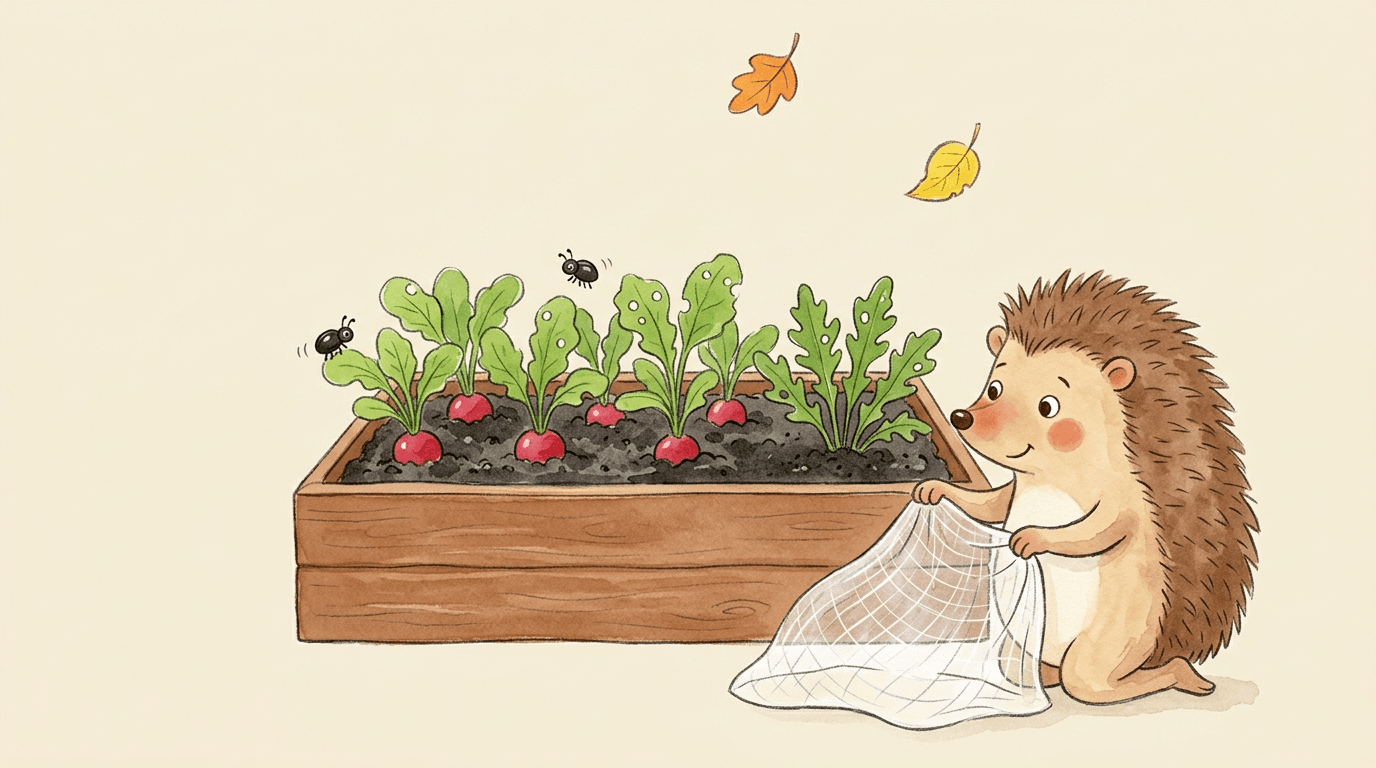
Mrs. Schneider comes to the fence with a radish leaf in her hand. "Stachi, look at this. Holes like someone went at it with a hole punch. And yesterday there were little black dots sitting on it – they jumped when I touched them."
Those are flea beetles. And if you let them carry on in late September, you won't have leaves much longer – you'll have sieves.
What flea beetles are (and what they're not)
Flea beetles are beetles, two to three millimetres long, shiny black or bronze-coloured. They're named for their habit of jumping like fleas when you get close. They're relatives of the leaf beetles, not of the fleas that live on cats.
They eat small, round holes into leaves – the technical term is shot-hole damage, because it looks like shotgun pellets in a target sheet. The worst-hit plants are the brassicas: radishes, rocket, mustard, pak choi, kohlrabi, broccoli, every kind of cabbage, and horseradish.
What they do not do: they don't eat carrot or tomato roots. If your carrots come out with holes, that's something else. Flea beetles stay with the cabbage family.
Why it kicks off again in autumn
Flea beetles have two main waves. The first in spring, April to May, when the overwintered adults emerge from the leaf litter and find the first radish sowings. The second in late summer and autumn, August to September, when the new generation hatches.
Both waves follow the same weather script: warm and dry – that's when they feed most. Rain and cool weather slow them down noticeably. That's why a dry, warm September like this one is a good year for the beetles.
Towards the end of September their activity gradually drops off. Once daytime temperatures stay below roughly ten degrees, things go quiet – the beetles look for their winter quarters. That's your window: what you sow now has a real chance of making it, if you protect it.
The catch: the young leaves you're growing now are exactly the most vulnerable. A freshly germinated radish has tender seed leaves, and if twenty beetles land on it, it's gone in two days.
How to identify it without guessing
The diagnosis is usually unambiguous once you know what to look for:
- Round holes one to two millimetres across, often in the middle of the leaf – not chewed from the edge the way slugs do it.
- If you stand close and touch the plant, small black dots jump.
- In a heavy infestation the leaf looks like a sieve and the plant barely grows.
- The worst damage hits the seed leaves right after germination.
A cross-check: slugs fray leaves inwards from the edge. Flea beetles punch straight through the middle. Once you can tell those apart, you've got half the diagnosis.
The one measure that reliably works: the net
If I could only recommend one thing, it would be insect netting.
A fine mesh – 1.3 millimetres or smaller – stretched over the bed without gaps, ideally right after sowing. The beetles are too big to get through, and they won't hop in under the edge as long as the net sits flush with the soil all the way round.
Three rules, or it won't work:
- Put it on before the seedlings come up. Once the plant is already infested, the net is only half as useful.
- Close it off at ground level with no gaps. Stones, ridges of soil or ground pegs all the way round. A finger-width gap is enough and the beetles will find it.
- Leave it on when you water. Lift it briefly, water, close it properly again straight away.
The net also helps against cabbage-white caterpillars and carrot fly. It's the investment that pays you back all season.
What else helps (in this order)
Keep it moist. Flea beetles love dry, warm surfaces. If you water in the morning and keep the soil evenly damp, the pressure drops immediately. Mulching with fine material keeps the surface moist – with the drawback that slugs like it too.
Sow trap crops. Deliberately sow a few rows of mustard or rocket at the edge of the bed, outside your crop. The beetles go there first. Once the trap crop fills up, cover it with netting or pull it out.
Yellow sticky traps. The sticky cards catch flea beetles, but only to a limited degree. Use them as an early-warning system, not as the whole solution. If a card is full after two days, you know the pressure is high.
Keep the ground clean. Flea beetles overwinter in plant residues and leaf litter. Clear cabbage stalks and old leaves in autumn instead of spreading them over the bed. Weeds from the cabbage family – shepherd's purse above all – have to go; that's where the beetles like to sit.
Encourage ground beetles. Ground beetles hunt flea-beetle larvae in the soil. A bed with compost, mulch and no winter digging has more of them. A paving slab or an old plank as shelter helps.
Use sticky film to collect them. Smear an old board with a strip of tape and hold it just above the plants, then tap the plant gently. The jumping beetles stick to it. Sounds fiddly, works well on small areas.
And chemicals?
You don't need them. In a home garden there's no chemical pesticide against flea beetles that's worth it relative to the damage. Everything that helps is growing practice: net, moisture, rotation, soil.
If you want to go after the larvae in the soil, you can use nematodes (Steinernema feltiae). But that only works in moist soil above twelve degrees soil temperature – in October it's usually too late. Save it for spring, when you sow radishes again.
Crop rotation: the mistake that makes it worse
Flea beetles live on brassicas. If you follow cabbage with radishes and then rocket on the same bed, you're farming them. The classic raised-bed mistake: radishes in spring, radishes again in autumn – and in between the beetles multiply undisturbed in the same spot.
Better: after the cabbage family, put something completely different in the bed for a year. Lettuce, carrots, onions, beans, herbs. Only after that, radishes again.
The concrete plan for late September
If you're still sowing rocket or radishes now:
- Net on immediately after sowing, no gaps, before the seedlings emerge.
- Water in the morning, keep the soil evenly moist.
- Sow densely and thin later rather than leaving gaps between rows – that way losing individual leaves matters less.
- Weed out anything from the cabbage family.
- When you harvest in autumn, clear the residues instead of digging them in.
If your radishes are already infested and the leaves look heavily perforated but are still green: water, keep them moist and wait. They'll keep growing. Only a plant with fewer than three leaves left is done for – pull that one.
Mrs. Schneider has gone for the net. She's never liked messing about with a spray bottle, and her bed is only two square metres. I expect a radish from her in three weeks, with a grin attached.
🦔 Stachi
Products mentioned in this post
- Plantura organic tomato seed set (10 varieties)Open-pollinated, good germination — robust for raised beds.
- Organic tomato seed set, 14 varieties
- Organic heirloom tomato seed set (Demeter, 12 varieties)
- Organic vegetable seed set, 10 varietiesCucumber, tomato, beetroot, broccoli, carrot, chard & more.
Related plants


More articles

October 10, 2026 · 2 min read
Planting blackberries in a raised bed this autumn: why one plant can already be too many
Frau Schneider ordered three thornless blackberry plants for her kids – all three meant for one single raised bed. I had to tell her that even one of them will outgrow it eventually. Here's what actually matters for an autumn planting.

October 9, 2026 · 2 min read
Blanching endive: the trick against bitterness – and where rot is lurking
Frau Schneider tied up her endive on a rainy afternoon because she didn't have time to wait. A week later the heart was brown and slimy instead of pale and tender. Here's what actually matters when you blanch it.

October 8, 2026 · 2 min read
Overwintering artichokes: why they freeze faster in a raised bed than in open ground
Frau Schneider's artichoke grew real buds for the first time this summer – now she's worried the plant won't survive the first hard frost in her raised bed. She's right to worry: raised-bed soil freezes differently from garden soil. Here's how to protect the rootstock properly.