September 24, 2026 · by Stachi · 5 min read
Winter Protection for Your Raised Bed: Fleece, Film, or Nothing at All?
Does your raised bed actually need a winter cover? When does fleece help, when is mulch enough – and when is nothing at all the right call. An honest guide.
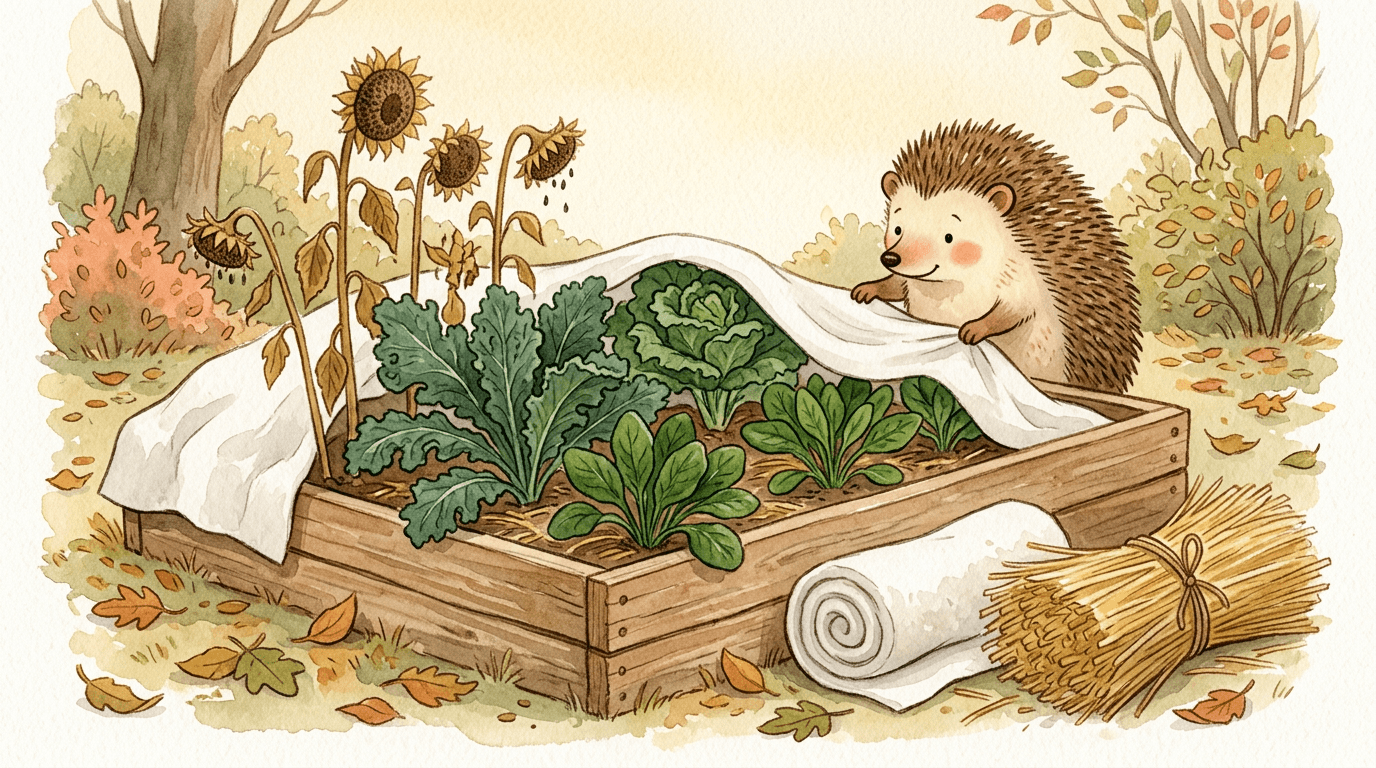
Every year in October, the same question comes up: do I need to cover my raised bed? With fleece? Film? Straw? Or just leave it alone?
The honest answer: it depends. But not on anything you don't know – it depends on three questions you can answer in two minutes.
🦔 Stachi here. Over the years I've tried every variation – unprotected winter bed, fleece tent, polytunnel, straw blanket. And I can tell you: the right system depends on what's currently in the bed. Not on what's on sale at the garden centre.
The three questions that decide everything
Question 1: What's growing in the bed?
This is the most important question of all. Depending on what's there, you need very different measures – or none at all.
- Empty bed (soil, maybe mulch): no winter protection needed. Lay mulch on top, done.
- Hardy plants (kale, winter purslane, lamb's lettuce, spinach): no protection needed down to -8 °C, fleece becomes worthwhile after that.
- Half-hardy plants (chard, Asian salad leaves): worth protecting from -4 °C, so fleece on cold nights.
- Tender plants you want to save over winter (young strawberry plants, herb pots): polytunnel or bring inside.
- Flower bulbs you've just planted: mulch is enough, no cover needed – they actually need the cold.
Question 2: What temperatures are coming your way?
In Switzerland and southern Germany: roughly speaking, elevations above 600 m get significantly more frost. In the lowlands – Zurich, Berne, Basel – winter minima typically fall between -5 and -12 °C on the coldest nights.
For fleece protection: P30 fleece (30 g/m²) protects down to about -5 to -7 °C. That's enough for lamb's lettuce and spinach on normal December nights at low altitude. For periods of persistent hard frost (below -8 °C for several days in a row), you can double the fleece or build a small tunnel.
Question 3: Do you want to harvest in winter, or are you just protecting?
This isn't a minor detail. Fleece keeps plants alive but makes harvesting awkward – you have to lift it every time, it mists up, and eventually it tears. If you just want protection, fleece is ideal. If you actively want to harvest, a polytunnel on steel hoops is the better solution: you can open it from the side, it lasts longer, and condensation drips off.
Fleece – the most widely used solution
Garden fleece, winter fleece, frost protection fleece – it's all the same thing. It's a thin, water-vapour-permeable polypropylene fabric that blocks frost while letting light and air through.
Pros:
- Cheap (roughly £2–3 per metre for P30)
- Light and rain pass through – no watering problem
- Plants can still breathe
- Quick to put up and take down
Cons:
- Doesn't hold up in very hard frost (below -8 °C) for long
- Tears if you keep pulling it up and down
- Slugs and mice can still get underneath
How to fix it down?
Clips, stones, soil anchors – all work. Important: fleece shouldn't lie directly on the leaves, otherwise the contact points freeze anyway. Either stretch it above the plants (with sticks or hoop frames) or lay it loosely with a bit of air space underneath.
Polytunnel – the more professional option
A polytunnel made of clear polyethylene film and metal hoops is more expensive (around £15–40 for a 120 cm bed), but far more durable and versatile.
When is it worth it?
- If you want to harvest over several months from behind your cover
- If you live at altitude or near mountain ranges
- If you want fresh salad leaves even in January
The problem with polytunnels: they store heat – far more than fleece. That's great against frost, but bad if the March sun suddenly shines on them and it hits 30 °C inside. You need to ventilate, regularly. Forget that, and you'll cook your winter salads.
Mulch – the often underestimated method
Mulch is not winter protection for plants growing above ground. But it does protect the soil and the roots.
What mulch actually does:
- Stops the soil from freezing too deep
- Retains soil moisture
- Protects plant roots (e.g. strawberries)
- Slows the freeze-thaw cycling that damages plants more than stable frost does
What mulch doesn't do: it doesn't protect leaves. A lamb's lettuce under 5 cm of straw would suffocate. Mulch goes beside or under plants – not on top of them.
Good mulching materials: straw (a bale from the farmers' market), dry leaves, dried grass clippings, shredded woody cuttings.
Doing nothing – when that's the best decision
With kale: covering it is counterproductive. Kale is so frost-hardy it actually needs sub-zero temperatures to convert starch to sugar and develop flavour. It's only really good after the first frost. No fleece, no protection – just leave it.
With lamb's lettuce and winter purslane: down to -5 °C they manage without help. In normal Swiss or Central European winter lowlands, that's usually not an issue until late November.
With an empty bed after the last harvest: add compost on top, add mulch on top, done. The soil does its winter regeneration, and that doesn't need a cover.
My tip for most raised beds
If you're not sure: buy 5 metres of P30 fleece (roughly £8–12). That's enough for a standard 120 × 80 cm raised bed. Then decide in November, once you see what's still in the bed and what the forecast says.
You only need a polytunnel if you actually intend to harvest through winter. Without that intention, it's not worth it.
And if your bed is empty: no fleece. Really. Let the soil breathe.
🦔 Stachi here: Most of the money spent in the garden goes on things you never needed. Winter protection is, nine times out of ten, a piece of fleece – or nothing. Don't let the colourful autumn aisle at the garden centre throw you off. Ask yourself first: what's growing in the bed? The answer gives you your winter protection.
And if the bed is empty: lay some mulch on top, make a cup of tea, and wait for spring.
🦔 Stachi
Related plants


More articles

October 10, 2026 · 2 min read
Planting blackberries in a raised bed this autumn: why one plant can already be too many
Frau Schneider ordered three thornless blackberry plants for her kids – all three meant for one single raised bed. I had to tell her that even one of them will outgrow it eventually. Here's what actually matters for an autumn planting.

October 9, 2026 · 2 min read
Blanching endive: the trick against bitterness – and where rot is lurking
Frau Schneider tied up her endive on a rainy afternoon because she didn't have time to wait. A week later the heart was brown and slimy instead of pale and tender. Here's what actually matters when you blanch it.

October 8, 2026 · 2 min read
Overwintering artichokes: why they freeze faster in a raised bed than in open ground
Frau Schneider's artichoke grew real buds for the first time this summer – now she's worried the plant won't survive the first hard frost in her raised bed. She's right to worry: raised-bed soil freezes differently from garden soil. Here's how to protect the rootstock properly.