May 7, 2026 · by Stachi · 8 min read
Strawberries in a Raised Bed — The 3-Year Growing Guide
No slugs, no muddy fruit, right at picking height — strawberries in a raised bed are the best thing that can happen to you in May. Which varieties actually deliver, when to plant, and why year two is when it all comes together.
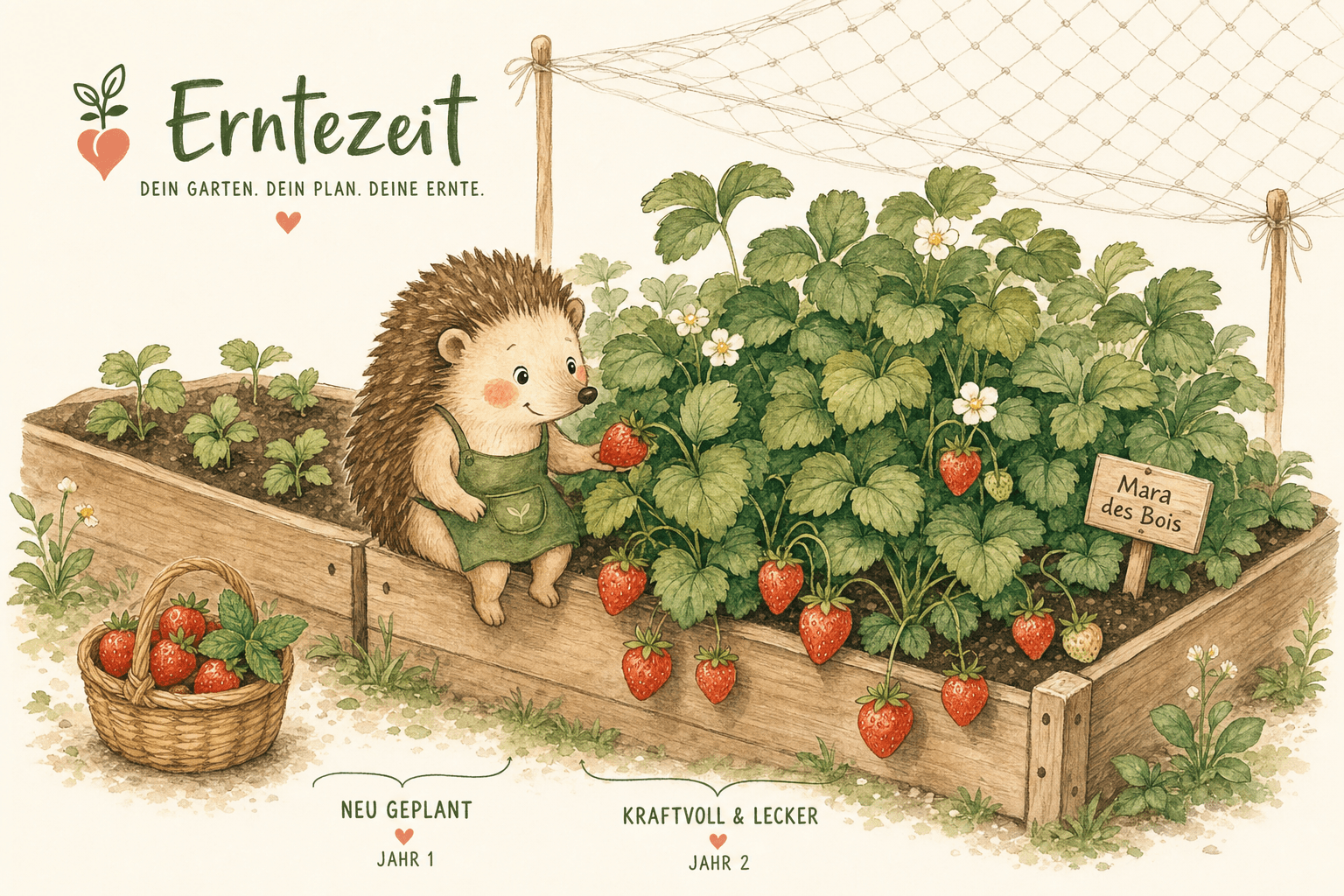
In May, everyone loves their tomatoes. Me too. But you know what I refuse to be without in June? Strawberries. Straight from the raised bed, no slug trails, no mud splashes from below, at exactly the right height to eat them as I walk past without bending down.
In my Berikon bed (120×80 cm, south-facing along the garden fence) I've had two strawberry varieties coexisting for two years now: "Mara des Bois" on one half, and the wild strawberry "Alexandria" as ground cover on the other. My neighbour Mrs. Schneider is always briefly disappointed that I don't grow a classic garden strawberry — then she tries a Mara and goes quiet.
This post is everything I know. Varieties, timing, the three-year plan, pests, and why the first year is intentionally small.
Which variety for which purpose
Before you grab whatever's at the garden centre, it's worth a minute on the three strawberry types. They don't just differ in flavour — they differ in how the harvest actually works, and that matters for a small raised bed.
June-bearing varieties — one big wave, then done
Classics like "Mieze Schindler" or "Senga Sengana" give everything in June. Two or three weeks of masses of fruit, then nothing until the season ends. The advantage: you know exactly when to make jam. The downside: your raised-bed strawberry slot is occupied for the rest of the season without producing much. Perfect for jam-makers like Mrs. Schneider. For those who prefer nibbling all summer: probably the second choice.
Everbearing varieties — May through October
"Mara des Bois" is the gold standard here. A French wild-type strawberry, bred in the Franche-Comté region, smaller than garden strawberries, far more intense in flavour. No single big harvest — instead a permanent supply: May, June, July, August, September, October, depending on conditions sometimes into mid-October. "Ostara" is sturdier and lower maintenance, similar idea. I chose Mara for the flavour and I'm happy to invest a little more care for it.
Monthly/wild strawberries — compact ground cover with intense flavour
"Alexandria" is tiny. The fruits are half the size of a normal strawberry, but the flavour is three times as intense. No runners, which makes it ideal as a ground cover in a raised bed: stays compact, suppresses weeds, causes no trouble. In my bed it fills the front strip. Not a yield miracle, but three or four mini fruits every day as "bonus picking" while passing by.
My mix: half the bed with Mara des Bois (everbearing), half with Alexandria (ground cover). For those who want more volume: Senga Sengana on one half, Mara on the other. Both worlds covered.
When to plant — and why timing matters more than you think
This is the biggest beginner mistake with strawberries: buy in spring, plant in spring, expect a big harvest that same year. It doesn't quite work.
The optimal planting window is late July to mid-August.
Sounds counterintuitive. But strawberry plants set in late summer have the whole autumn to build roots. They go into winter well-established. The following spring they start with a head start, flower earlier, produce more. A plant set in August 2026 delivers the full harvest in 2027.
Spring planting works too — but with caveats. Transplants that go in April or May have barely any time to build roots before the first flowers appear. Many growers actually recommend pinching off all blossoms in the first year after a spring planting, so the plant puts energy into roots rather than fruit. It feels brutal, but pays off in year two.
I planted my Mara in August. First winter, well-rooted. Second year, real harvest. Had I waited until April, 2027 would have been my first proper harvest year — a year given away for free.
Spacing: 30 cm between plants, 30-40 cm between rows. Looks generous in April. By July each plant is a small bush and you'll be glad of the room.
The crown must be visible. When planting, the crown of the plant — the "heart" where the leaves emerge — must sit exactly at soil surface level. Not deeper (the crown will rot), not higher (it will dry out). This is the most common planting mistake with strawberries, and it costs more plants than all the slugs put together.
Care — what actually makes the difference
Strawberries in a raised bed are easier than in the ground, but "easier" doesn't mean "no maintenance." Three things make the real difference:
Straw or fleece under the fruit
As soon as the strawberries start to develop (May for early varieties, mid-May for Mara), I lay a thin straw mulch under the plants — two centimetres is enough. It keeps the fruit clean when it rains, prevents direct soil contact, and massively reduces mould risk. In a raised bed, mould on fruit is the biggest issue — air circulates from all sides, but fruit touching damp soil rots faster than anything else.
Fleece works too, but looks slightly odd in a raised bed. I use straw.
Watering — steady, at the root
Strawberries like consistent moisture, not extremes. Watering intensively once a week and then letting the bed dry out completely: bad idea. Drought stress leads to small, bitter fruit. Too much water leads to mould.
In a raised bed, which dries out faster than an in-ground bed, this means: in high summer, water every day or every two days, in the morning, at the root, never over the leaves. Wet leaves plus heat equals mildew and grey mould. A drip-irrigation system with a timer is the most sensible investment you can make for strawberries — 30-40 francs for a basic setup, perfectly watered every day with zero effort.
Fertilising — less than you think
One handful of well-rotted compost around each plant in spring: that's it. No liquid fertiliser, no granules, no specialist strawberry feed from the garden centre. Strawberries that get too much nitrogen produce magnificent leaves and barely any fruit. The plant "thinks" it has enough resources and grows instead of reproducing.
If by year two you notice the harvest weakening: compost in spring one more time. That's all.
The three-year plan
This is the core of why strawberries in a raised bed work slightly differently to other vegetables. Strawberry plants are perennials — but they follow a natural three-year rhythm.
Year 1 — Building
Whether you plant in summer or spring: the first year belongs to root development. You'll see growth, you'll see flowers, you may harvest some fruit. But the harvest is small, sometimes disappointing. That is normal and correct.
What matters in year 1: remove runners. Strawberry plants produce runners — horizontal shoots that want to form new daughter plants. In the first year, remove them all. Every runner the plant invests in a daughter plant is energy taken from fruit production. You want one strong mother plant, not a colony of weak daughters.
In years two and three you can let the odd runner root — as a reserve for year four, when the mother plant needs renewing.
Year 2 — The main event
This is why you grew strawberries in a raised bed. Well-rooted plants at full strength, optimal conditions, full harvest. My Mara in its second year produced enough to harvest every day. Not Mrs. Schneider's jam volumes, but easily 500 grams a week from half a raised bed.
1 m² of raised bed, well planted, realistically delivers 2-3 kg of strawberries per season in year 2. With everbearing varieties, spread from May to October.
Year 3 — still good, then done
The harvest is still decent, perhaps 70-80% of year two. The plants are no longer quite as vital, forming more woody growth, fewer new fruit buds. Enjoy the harvest, but already plan the renewal.
After year 3 — avoiding soil fatigue
This is critical: after three years you should not plant strawberries in the same spot of the raised bed again. Strawberries deplete certain soil nutrients and leave behind pathogens that harm new strawberry plants. This is called soil fatigue.
Solution: use the other half of the bed, or — if the bed is small — bridge three years with other vegetables before strawberries go there again. In a larger bed: rotate strawberries one position every three years.
Pests and common problems
Birds
The biggest problem. Blackbirds, starlings, and anything with a beak finds ripe strawberries just as attractive as you do. Solution: a simple bird net over the raised bed once the first fruits start to redden. In a raised bed this is easier than in the open ground — the net stretches over the edge and clips in place.
In my first strawberry year I skipped the net and learned: the blackbirds are faster than me.
Grey mould (Botrytis)
Grey mould grows on the fruit — grey fuzz, usually where fruit touches other fruit or lies on damp soil. Prevention: straw mulch, good air circulation, watering at the root not over the leaves. Remove affected fruit immediately (don't leave it in the bed — mould spores spread quickly).
Woody plants after year 3
After three years the shoots become woody, the plant produces less. That's not a pest — it's the natural lifecycle. Renew using runners you deliberately rooted in year two or three, or buy new transplants at the garden centre.
Spider mites in heat
During heat waves and very dry conditions, spider mites can colonise the leaves — visible as a fine web on the underside and increasingly bronze- coloured foliage. Regular root watering and occasionally hosing down the leaves (mornings only!) helps. For severe infestations: a biological spider-mite treatment from the garden centre.
What you can expect
1 m² of raised bed, everbearing variety Mara des Bois, well cared for:
- Year 1: 300-700 grams (depending on planting time)
- Year 2: 2-3 kg across the season (May-October)
- Year 3: 1.5-2 kg
Three years, roughly 5-6 kg of strawberries from one square metre. Mrs. Schneider makes jam from the peak harvests; I eat most of mine directly at the bed. There is no better use of a strawberry than the direct route.
If you haven't done your raised bed plan yet — the strawberry section needs thought. Where does the sun hit? What else is planted nearby? (Strawberries get on well with garlic and lettuce, less so with brassicas.) And when is the space free for rotation after three years?
That's what I plan in Erntezeit — location, bed, plants, and then the plan shows where strawberries make sense and when the rotation is due. Set it up once, enjoy it for three years.
For more on raised bed basics, see my beginner's guide to filling a raised bed, and if you're still deciding which plants to grow, the five varieties that always work is a good starting point.
Plan your bed for free → /en/planer/standort
🦔 Stachi
Related plants


More articles
October 26, 2026 · 3 min read
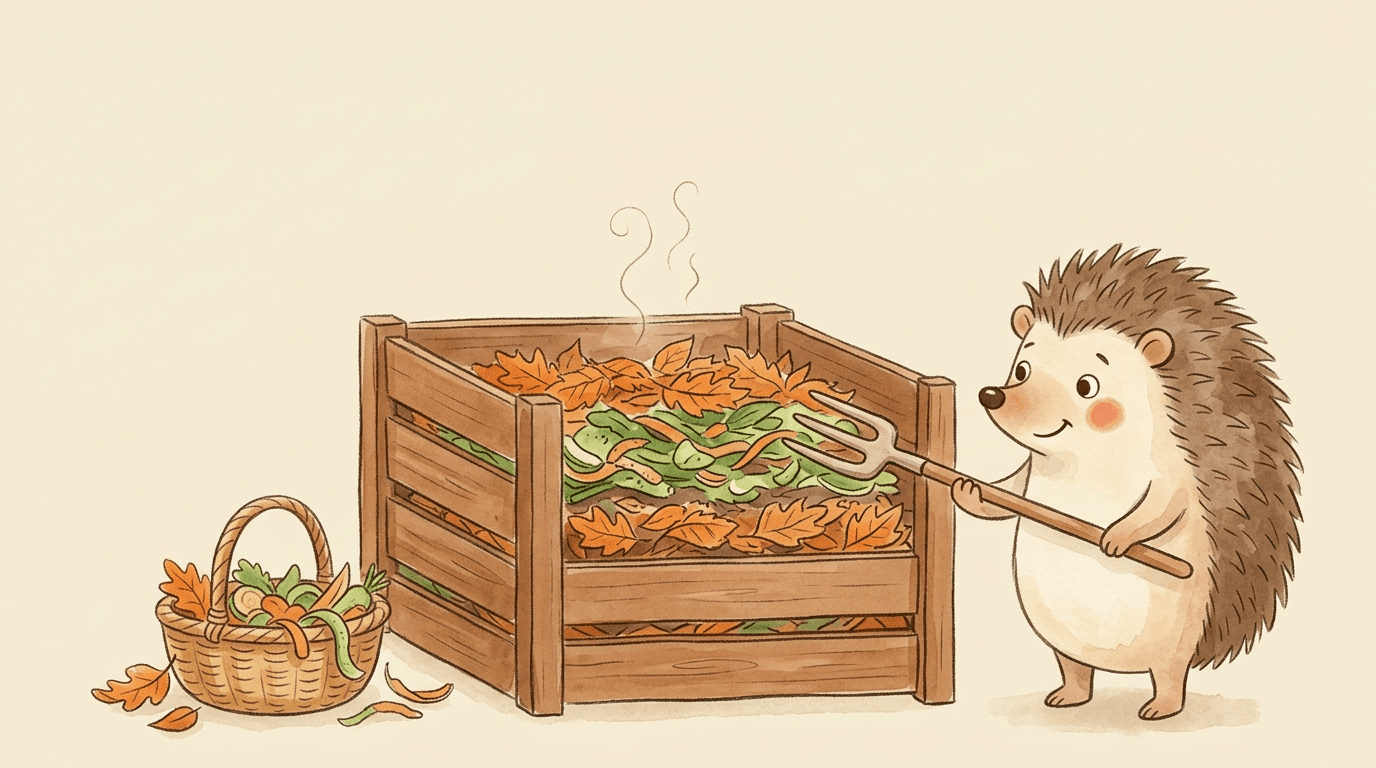
Starting an autumn compost pile: 3 parts leaves, 1 part kitchen scraps
Frau Schneider's compost pile just sat there all winter. No steam on cold mornings, no warmth, no breakdown — just a heap of dry leaves that hadn't changed a bit by March. The problem wasn't patience. It was the mix.
October 20, 2026 · 3 min read
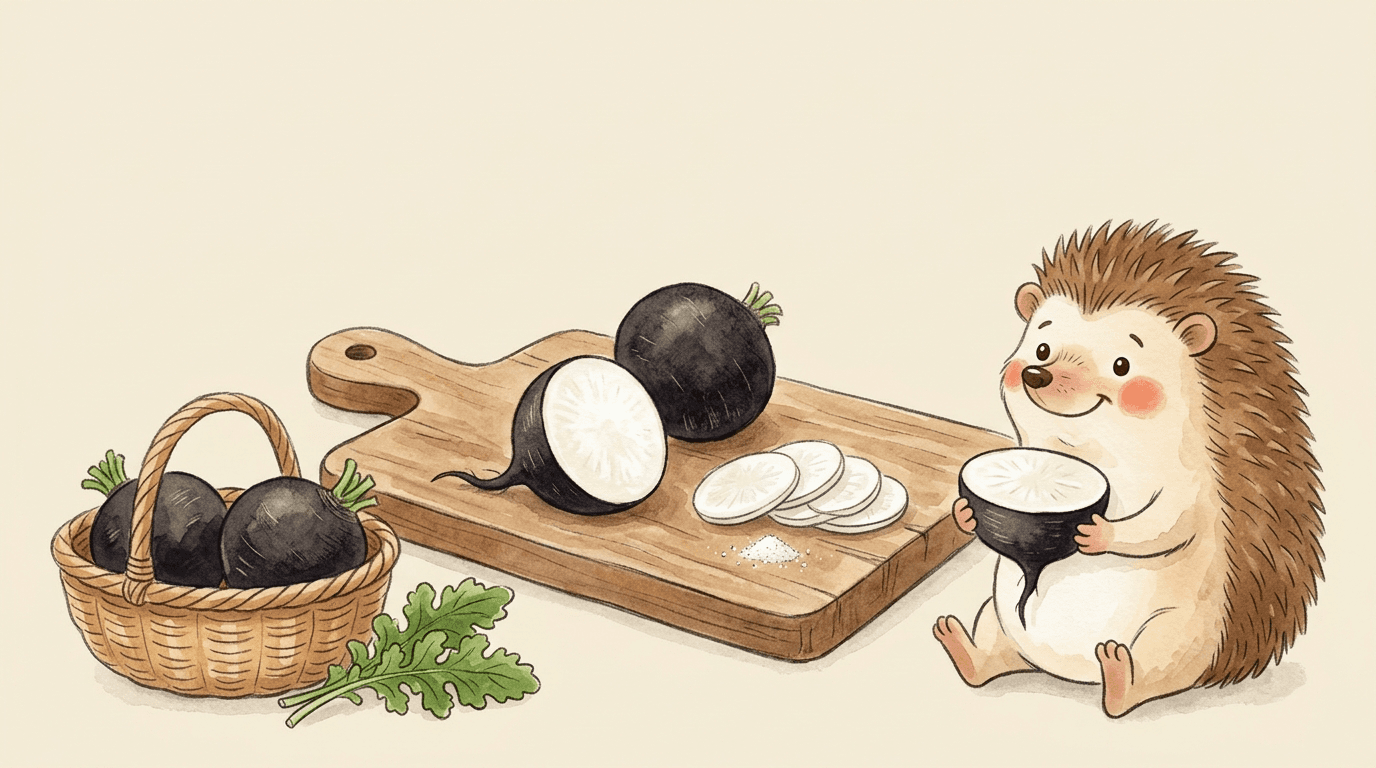
Black radish: why you should let it rest before you bite in
Last year Frau Schneider bit straight into one, unsalted, fresh out of the ground, and spent the next two minutes coughing instead of talking. The problem wasn't the radish. It was the timing.
October 14, 2026 · 2 min read
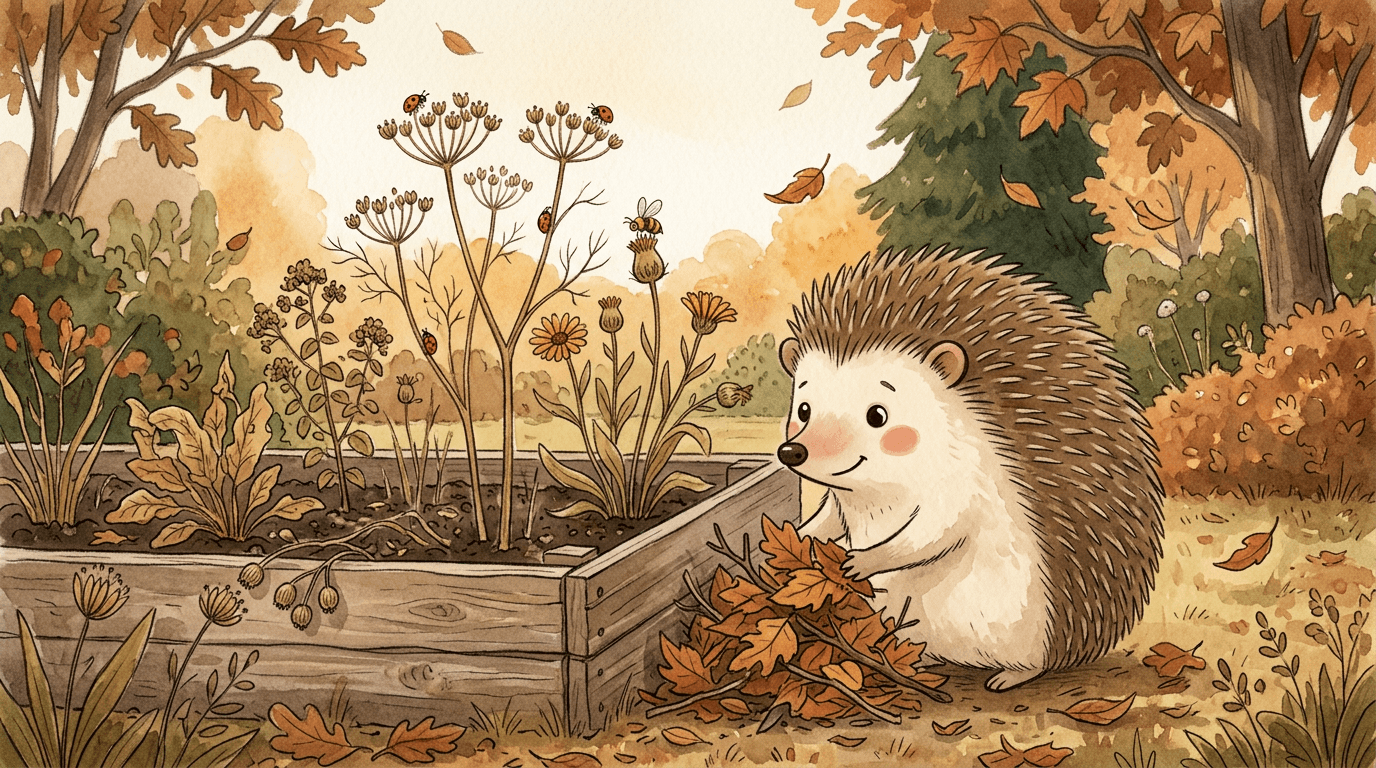
Why I only tidy up half my raised bed in October
Mr Zimmermann cut his entire raised bed down to the ground in one afternoon — stalks, seed heads, leaves, all gone. I should have warned him beforehand: not everything, only half. Here's what should stay standing and what really needs to go.