May 6, 2026 · by Stachi · 7 min read
My raised bed only gets 3 hours of sun — what's actually worth growing?
Behind the shed, under a walnut tree, against a north wall — not every raised bed has guaranteed sunshine. 10 varieties that deliver anyway. And three you can skip.
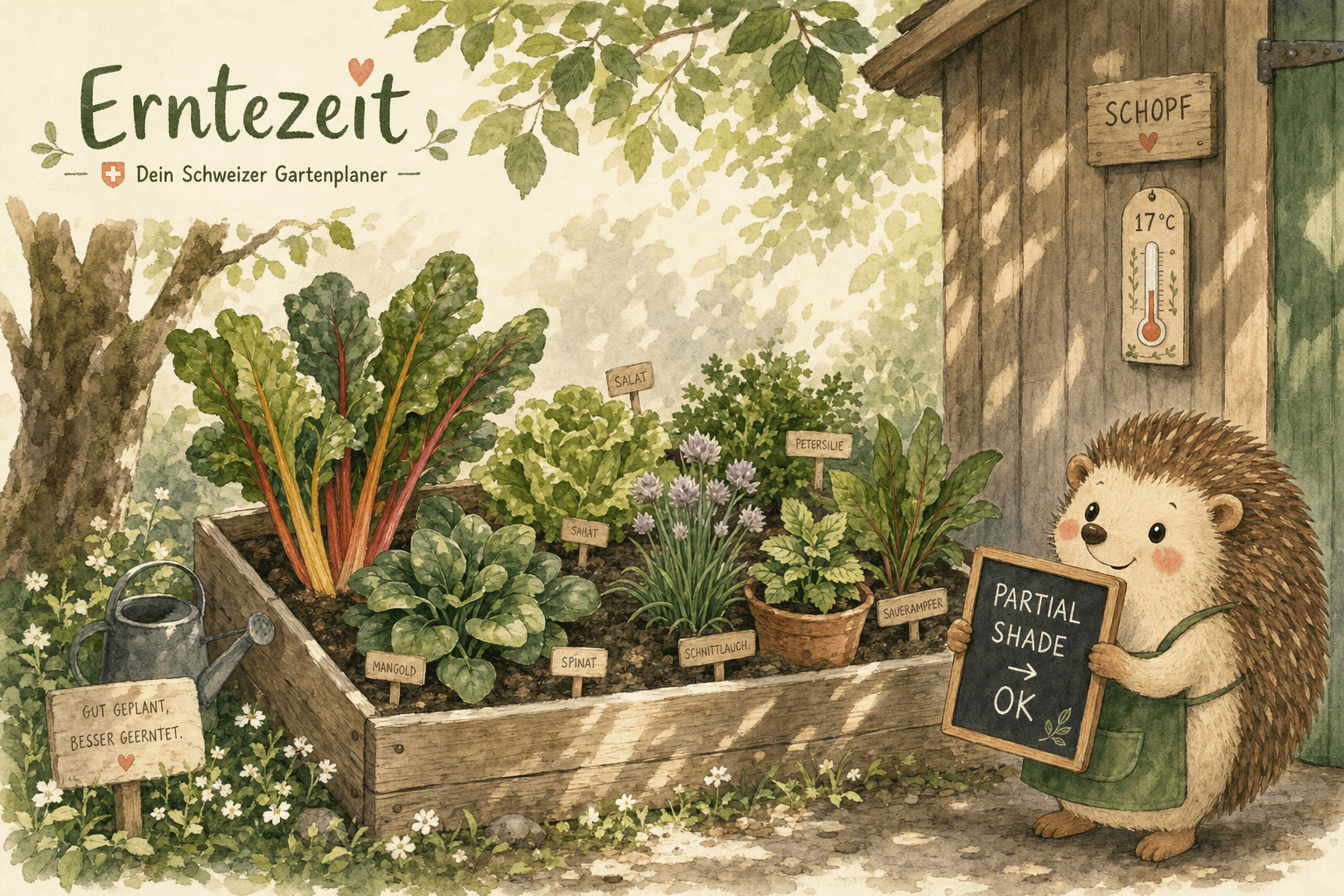
My raised bed in Berikon stands behind the garden shed. Not by choice — it was the only spot that my neighbour Mrs Schneider wouldn't grumble about over the fence. Morning sun from about 8 until 11, then partial shade for the rest of the day.
In my first year I thought: That's not enough. Nothing will grow.
I nearly only tried tomatoes, nearly only sighed, and nearly gave up on the whole bed. Instead I discovered: a shaded raised bed isn't second-rate. It's different. And for a good dozen varieties, it's actually better.
What plants really need — and what's often misunderstood
When gardening books talk about "full sun" and "partial shade," they almost always mean direct hours of sunlight, not brightness as such. That's an important distinction.
A spot can be bright without any direct sun — for example when a light- coloured house wall reflects, or when light falls diffused through tree canopy. Diffuse light is nearly as valuable for most leafy vegetables as direct sun, and sometimes more so: less heat stress, slower bolting.
A rough guide:
- Full sun = 6+ hours of direct sun daily — tomato, pepper, aubergine
- Partial shade = 3–6 hours of direct sun — lettuce, chard, pak choi, most herbs
- Shade = 1–3 hours of direct sun — mint, sweet woodruff, lovage
One tip I only learned after two seasons: bright materials around the bed help more than you'd think. A light-coloured wall behind the bed, white gravel in front, pale wood on the bed sides — in a shaded bed, that can add the equivalent of half an hour of light. My shed has a white-painted back wall. Coincidence. It's helped me season after season.
10 varieties that genuinely deliver in my shed-bed
All figures refer to minimum hours of direct sun per day. With diffuse light, you can subtract roughly 30–60 minutes.
1. Rainbow chard — from 2 hours
Chard is my favourite in the shaded bed. Once sown, you keep cutting and it keeps growing back. It barely bolts — chard only does that in serious heat, which we get less of in partial shade.
The coloured-stem varieties (rainbow chard) are just as vivid in the shade as in the sun. Maybe even a little more intense. At least that's what I tell myself.
Care: Water consistently, don't let it dry out. When harvesting, always take the outer leaves first and leave the centre alone.
2. Spinach — from 2 hours
Unbeatable in spring and autumn. It bolts in heat in summer — but we get much less of that in a shaded bed. That means: spinach in a shaded bed often has a longer harvest window than in a sunny one.
Still getting hot in June or July? Swap spinach for chard or pak choi, which handle the heat better.
Care: Keep moisture even. Pull bolting plants straight away — they make everything else bitter.
3. Pak choi — from 3 hours
Pak choi is fast. 30–40 days from sowing to harvest, depending on the variety. That makes it ideal for a second or third sowing in the same season — when the first round is harvested in early August, you can put the next straight in.
In shade it bolts less readily than in full midday sun. That's reason enough for me.
Care: Watch out for slugs — they love pak choi almost as much as I do. A beer trap works well.
4. Loose-leaf lettuce — from 3 hours
Lollo Rosso, oakleaf, Batavia — all cut-and-come-again lettuces cope well with partial shade. The trick is picking individual leaves rather than the whole head: take the outer leaves and let the inner ones keep growing.
A small bonus in the shaded bed: lettuce stays more tender in flavour. I'm not just saying that. Mrs Schneider confirmed it after I handed a bag of leaves over the fence. She complains less often now.
Care: Harvest regularly — it encourages growth. Remove yellowing leaves immediately.
5. Parsley — from 3 hours
Flat-leaf, curly-leaf — both do well in partial shade. Flat has more flavour, curly looks neater. In a shaded bed it grows more slowly than in sun, but less frantically. You keep up easily.
One small warning: parsley is biennial, meaning it takes two growing seasons to reach full strength. If you want to harvest soon, it's better to buy a plant than start from seed.
Care: Don't over-harvest. Take no more than a third of the leaves at once, or it struggles to recover.
6. Chives — from 2 hours
Perennial, tough, plant them once and let them get on with it. Chives forgive partial shade so reliably that in my shed-bed they've become the most stable element of the whole planting.
Harvesting starts in early spring, another flush in autumn — and again the following year. When they flower (pretty purple blooms), cut them before they set seed or they'll spread.
Care: Almost none. Cut back to 3–4 cm once a year after harvest. That's it.
7. Mint — from 1 hour
Mint is the most easygoing plant I know — and the most devious. It grows anywhere, tolerates almost no light, no cold, no hardship. And it spreads. Underground. Uninvited. In all directions.
Plant it in a pot, then put the pot in the bed. Without a pot it claimed half of my bed in two seasons — I say this from personal experience.
With a pot, it's wonderful — fresh tea, summer drinks, everything good.
Care: Water it. Cut it back hard once a year.
8. Lovage — from 2 hours
Known in German as Maggikraut — the flavour is unmistakably like Maggi seasoning. Not everyone's taste, but if you like it, you get a perennial, robust herb supplier for almost no effort.
Lovage grows large — 1.5 to 2 metres in a corner of the bed is realistic. But it delivers for years with little care, and it actually prefers partial shade over full midday sun, where the essential oils can burn off.
Care: Cut back to 10 cm in autumn. It comes back in spring.
9. Sorrel — from 2 hours
Little known, absolutely worth trying. Sorrel tastes slightly sour, almost lemony — excellent in salads, as a flavouring in soups, or just eaten raw straight from the bed (my preference).
Perennial, frost-hardy, shade-tolerant. Bolts in summer — when that happens, just cut it back and it regrows with fresh leaves.
Care: Minimal. Cut bolting stems, water. Done.
10. Sweet woodruff — from 1 hour
The woodland-floor plant of my bed collection. Sweet woodruff needs almost no light — in nature it lives under the forest canopy, where it gets perhaps 1–2 hours of diffuse light in summer.
In the raised bed it's not a showstopper visually, but it delivers a really distinctive flavour for cordials, lemonades, and desserts. And it grows reliably.
Care: Keep moist, avoid direct midday sun. Protect in winter with mulch or fleece, and it'll re-emerge in spring.
Forget these three in a shaded bed
Tomato. It needs 6–8 hours of direct sun, consistently. Without that: small, tough fruits, high blight risk, a long wait for ripeness — if it happens at all. I've tried it. Please don't.
Pepper. Even more heat-hungry than the tomato. In my shed corner, my pepper experiment reached about 20 cm, produced four tiny fruits after a full season. Those four fruits tasted good. The effort wasn't worth it.
Aubergine. A Mediterranean plant. It loves heat and long bright days. In a shaded bed in Switzerland: theoretically possible, practically disappointing. Better to put your energy into plants that actually work.
A shaded bed isn't second-rate — it's different
That sounds like consolation. It isn't.
I enjoy the lettuce from my shed-bed more than anything I harvest from the sunny side. It's more tender, less bitter, and it keeps longer after picking. The chard has deeper colours. The herbs smell more intense, because they grow more slowly.
I do miss the tomato. I grow that in a pot on the south side of the house. But the shed-bed has been mine for three years now, and I wouldn't give it up.
If you have a bed behind the house, under a tree, against a north wall, or under a canopy — try the list above. You'll be surprised how much actually works.
And if you want to know which of those fit your exact location and bed size: Plan your bed for free →
I'll look at your climate zone, frost dates, and available space, and suggest a plan that genuinely suits your bed. Shaded beds included.
Plant something tender.
🦔 Stachi
This post is part of the Erntezeit series on practical raised-bed know-how. More: Planting a raised bed — the beginner's guide · Five plants that always deliver · The last centimetre — filler plants
Related plants


More articles
October 26, 2026 · 3 min read
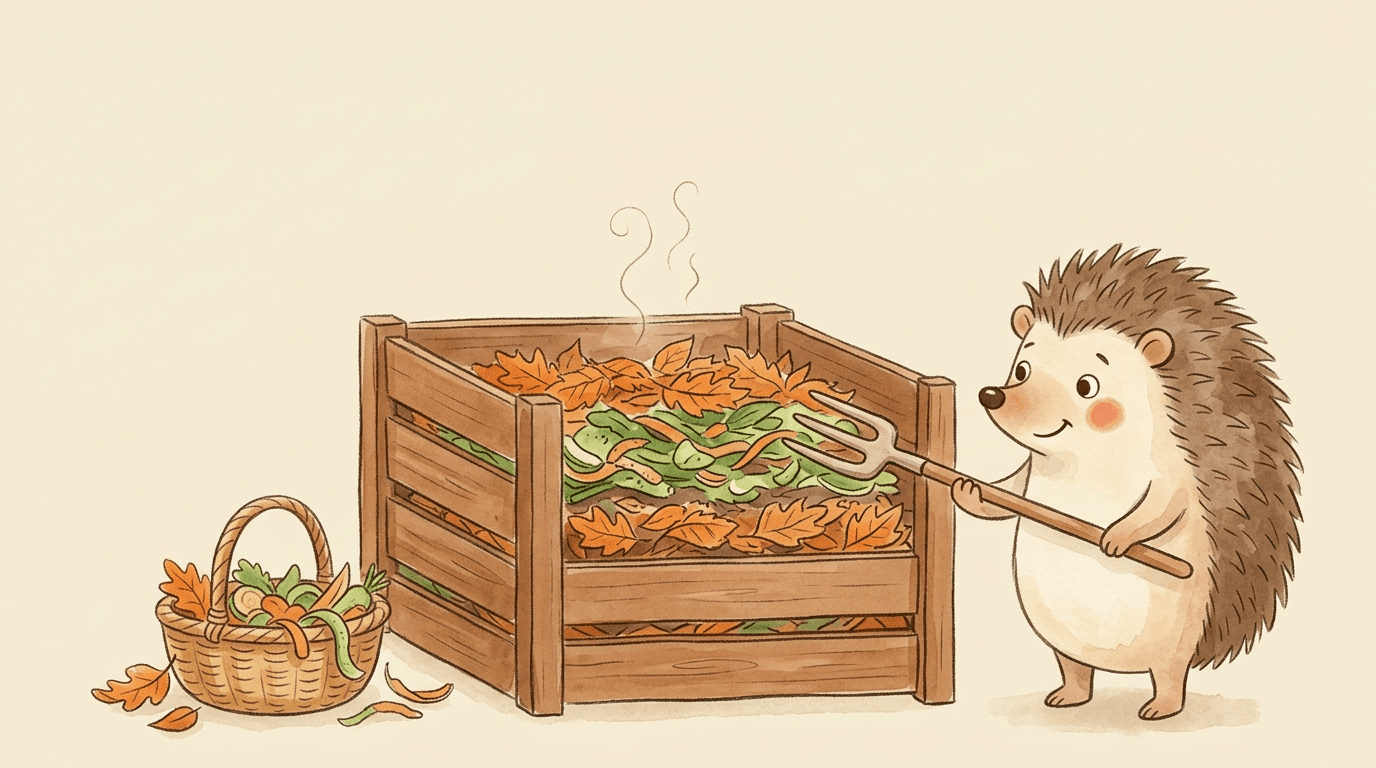
Starting an autumn compost pile: 3 parts leaves, 1 part kitchen scraps
Frau Schneider's compost pile just sat there all winter. No steam on cold mornings, no warmth, no breakdown — just a heap of dry leaves that hadn't changed a bit by March. The problem wasn't patience. It was the mix.
October 20, 2026 · 3 min read
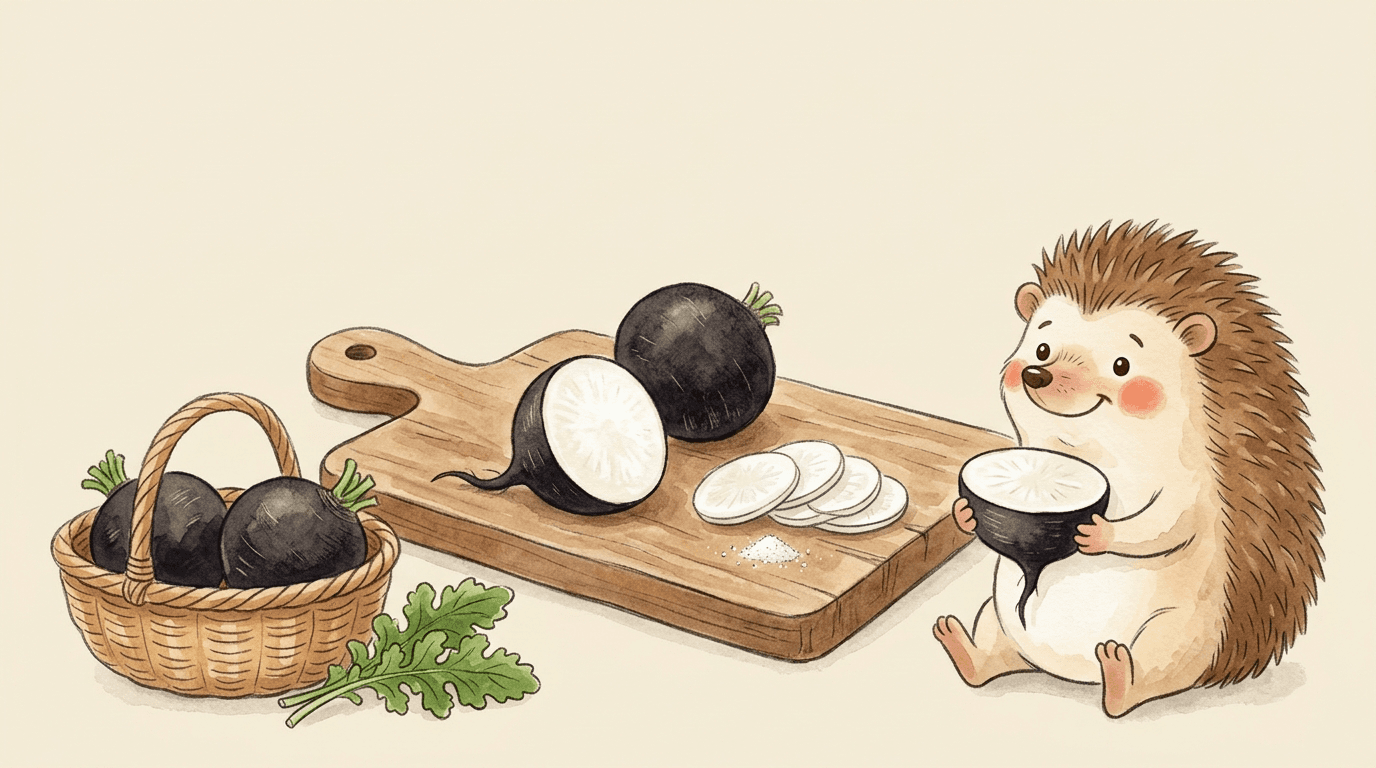
Black radish: why you should let it rest before you bite in
Last year Frau Schneider bit straight into one, unsalted, fresh out of the ground, and spent the next two minutes coughing instead of talking. The problem wasn't the radish. It was the timing.
October 14, 2026 · 2 min read
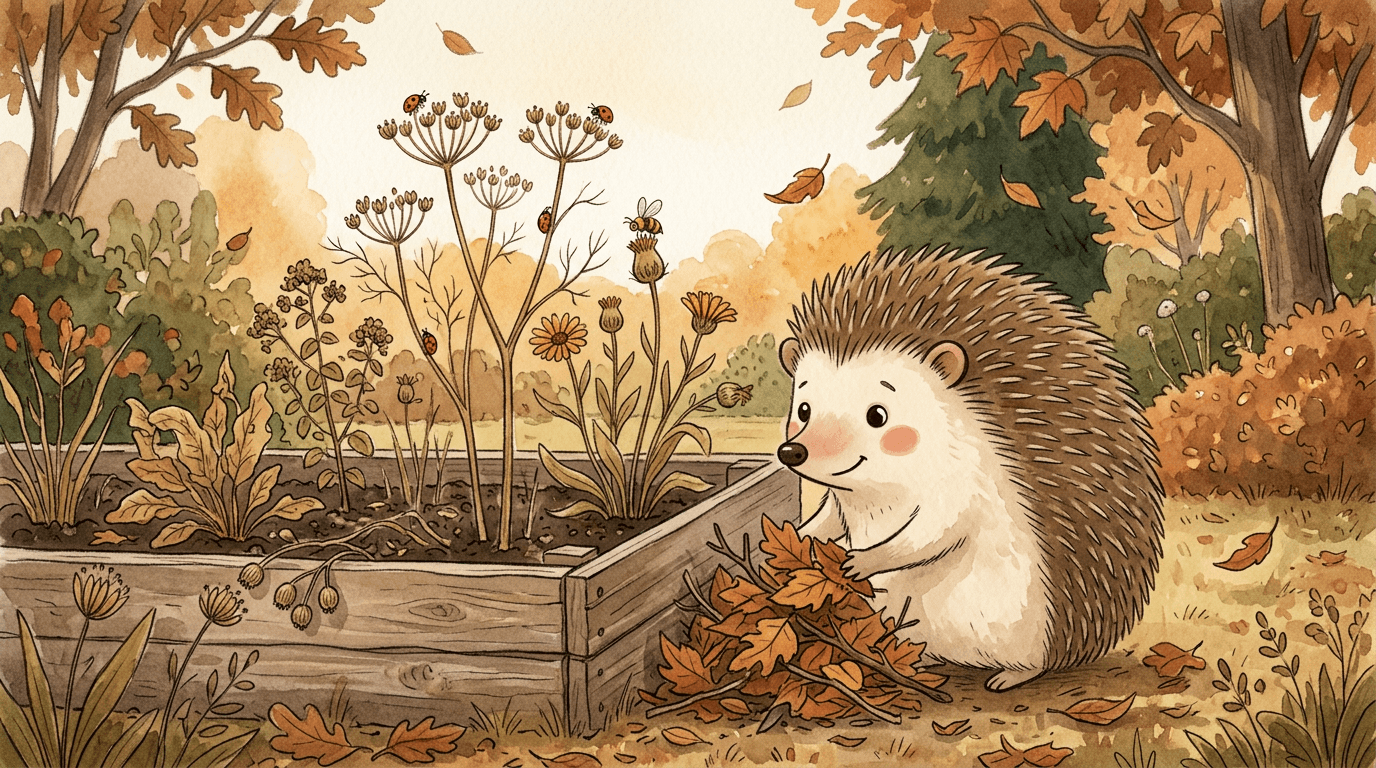
Why I only tidy up half my raised bed in October
Mr Zimmermann cut his entire raised bed down to the ground in one afternoon — stalks, seed heads, leaves, all gone. I should have warned him beforehand: not everything, only half. Here's what should stay standing and what really needs to go.