May 4, 2026 · by Stachi · 10 min read
How to Fill a Raised Bed the Right Way — the 4-Layer Method
Why you can't just dump soil into a raised bed, and how four layers keep it warm, fertile, and productive for five years.
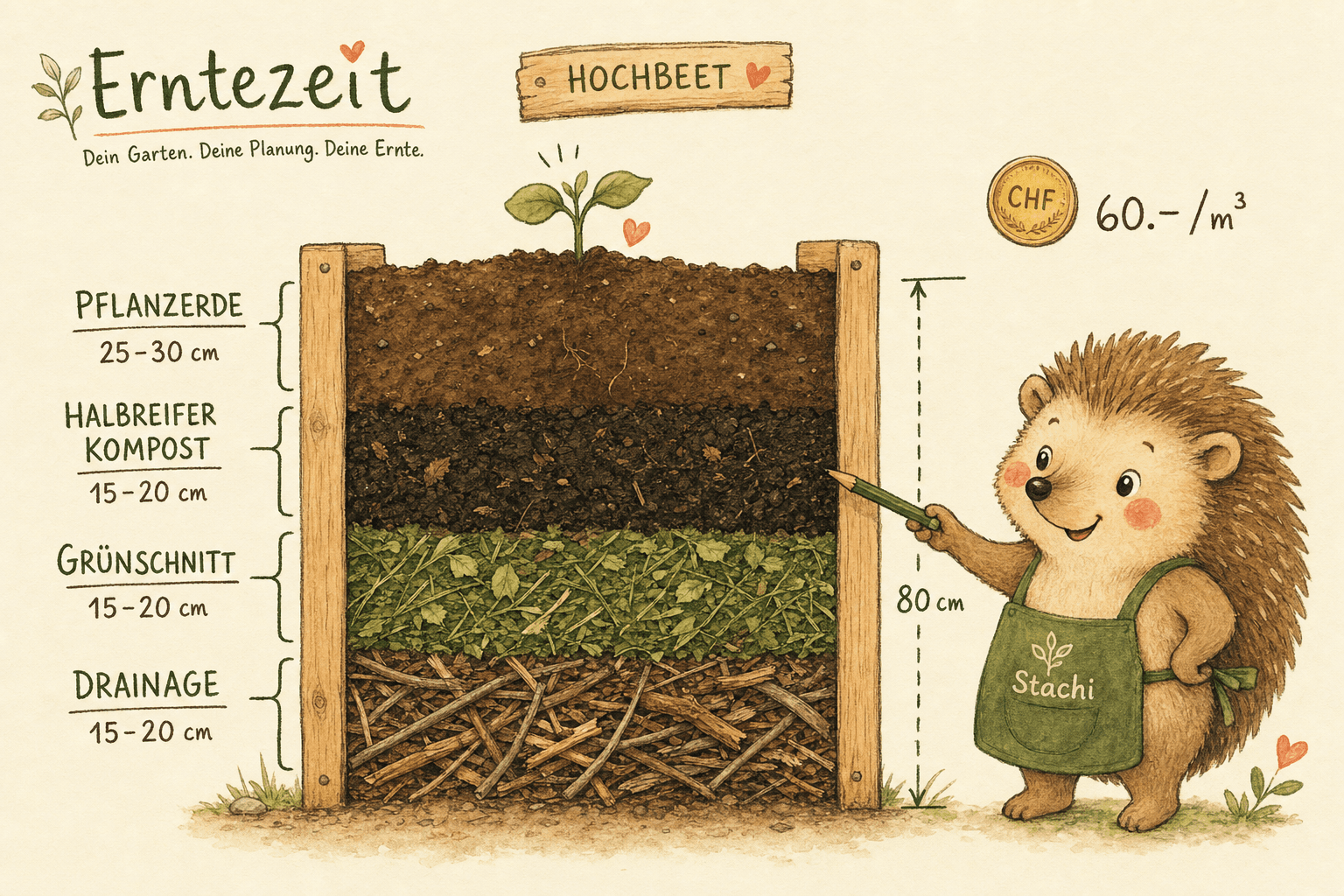
Mrs Schneider from Berikon bought her first raised bed last autumn. One of those beautiful larch-wood ones, 200×80 cm, 80 cm deep. It stood in the garden all winter. Empty. I spent the whole winter explaining that she shouldn't just tip soil into it. She nodded, nodded, and in March called the garden centre to order "one bag of raised-bed compost."
I didn't pick up the phone fast enough.
This mistake is made by almost everyone who buys a raised bed for the first time. The thing just sits there, you want to get going, and "soil in, plants in, done" sounds perfectly logical. But it isn't — not because I want to make things complicated, but because a raised bed without proper layering collapses after two years, drains badly, and fails to deliver on its nutrition promises.
Four layers. In the right order. Then the bed lasts five years.
Why layers at all?
Before I explain the four, a quick "why" — because it helps you understand what "wrong" actually means if you do it differently.
Decomposition heat. Organic material breaking down generates heat. A properly filled raised bed can be planted two to four weeks earlier in spring than a flat garden bed — because the soil is warmer from below. That's not a marketing claim, it's biology. But for that you need material that actually decomposes. Pure bought soil doesn't.
Slow nutrient release. Compost and manure in the middle of the layering release their nitrogen slowly — over months, sometimes years. The first year is the most abundant, the second still good, from the third year you top up. A layer of bought soil with a bag of granular fertiliser gives you nutrients exactly once — and then nothing.
Drainage. Water must be able to drain away. A raised bed without drainage collects water at the bottom, the soil compacts, roots rot. The bottom layer of coarse material is the system's drain — not a luxury extra, but essential.
Structural stability. An empty raised bed filled with 80 cm of bought soil will sink 15 to 20 cm in the first year. That's normal — soil settles. With proper layering it sinks too, but more evenly and slowly, because the coarse material at the bottom carries the weight. And when you top up in the second spring, you know exactly why and what to add.
The four layers — from bottom to top
A typical 80 cm raised bed. All measurements are for this height.
Layer 1: Drainage (15–20 cm)
The foundation. Right at the bottom.
What goes in: Thicker branches, twigs, coarse wood chips. Branch diameter of 5 to 10 cm is ideal — thicker decomposes too slowly, thinner decomposes too fast and leaves an air pocket in year two. You can also use old untreated boards. The material doesn't need to be uniform — a wild mix of branches of different thicknesses actually works better than uniform pieces, because it naturally forms cavities that drain water away.
What does NOT go in: Mouldy wood (it transfers fungal spores through the whole bed), treated/painted wood (chemicals in the soil), and — importantly — walnut branches and walnut leaves. Walnuts contain juglone, a natural growth inhibitor that stunts or kills many vegetable plants (especially tomatoes and peppers). If you have a walnut tree in your garden, keep its branches out of the raised bed.
Purpose: The coarse wood decomposes over three to five years, releasing heat and nitrogen in the process. At the same time it's porous enough for excess water to drain downward rather than pooling.
Layer 2: Green cuttings (15–20 cm)
The transition layer. Directly on top of the drainage.
What goes in: Shrub cuttings (including thinner branches up to thumb-thickness), lawn clippings, leaves (dry, not wet and matted), pruned perennial stems, kitchen waste without meat. This layer fills the gaps between the branches in the drainage layer and creates a bridge to the compost above.
What does NOT go in: Freshly mown, still-wet, matted lawn clippings in thick clumps. These will mould rather than decompose, and you'll get rot spots in the middle of your bed in summer. Grass clippings yes — but in thin layers, mixed with other green material, not as a solid damp mat.
Purpose: Green material decomposes faster than wood and generates the first noticeable heat. This is the layer that warms the bed from the inside in spring — you can literally feel it by putting your hand 10 cm deep. In a freshly filled autumn bed, the green-cuttings layer is still warm in March.
Layer 3: Semi-mature compost or manure (15–20 cm)
The heart of the system. The nutrient bomb.
What goes in: Your own compost from the middle of the decomposition process — not the finished black humus right at the bottom of the compost bin, but the dark brown, still-recognisable material from the middle zone. Or: rotted horse manure (six to twelve months old, not fresh), rotted cattle manure (milder, more consistent than horse), or rotted sheep manure (more concentrated, smaller quantities needed).
A brief manure comparison:
- Horse manure: very nutrient-rich, lots of heat during decomposition, straw content good for soil structure. Minimum six months maturing time. Most commonly available from riding stables — often free or very cheap if you collect it yourself.
- Cattle manure: milder in nitrogen, fewer pH extremes, better for sensitive crops. Also six months.
- Sheep manure: compact, highly concentrated, a little goes a long way. Caution: use slightly less than the others — sheep manure can acidify the soil if you overdo it.
What does NOT go in: Fresh manure, straight from the stable. Fresh manure burns roots — it releases so much ammonia as it decomposes that young plant roots die in it. Let it mature on a pile for at least six months before it goes into the bed. If you're buying from a riding stable, just ask how old the pile is.
Purpose: This layer is the nutrient tank. It releases nitrogen, phosphorus and potassium slowly over months — sometimes two to three years. The first harvest directly above this layer gets the most generous feed. From year three onwards you top up with compost from above.
Layer 4: Planting soil (25–30 cm)
The working layer. Right on top.
This is the only layer where your vegetable roots spend most of their time. 25 to 30 cm — no less. If you scrimp and put only 15 cm of soil on top, you'll get root vegetables that can't go deep enough (carrots, parsnips), and all other plants that can't reach down during dry spells.
Option 1: Buy ready-made raised bed soil. The easiest solution. Quality varies — I recommend one with a wood-fibre component (it says so on the bag), which keeps its structure longer. Cost: 40 to 60 CHF per cubic metre at the garden centre. For a 200×80 cm bed with a 25–30 cm layer you need about 0.4 m³ — one good cubic-metre bag or four 50-litre bags.
Option 2: Your own mix. Your own garden soil (good quality, not heavy clay) plus finished compost (black, crumbly, almost no smell left) in a 70:30 ratio. Cheaper, better for soil biology, slightly more effort. If you have clay soil: improve it with sand first (add 20 per cent sand) before mixing with compost, otherwise you'll get soil that cracks when dry and clogs like putty when wet.
What does NOT go on top: Pure compost or pure manure as the top layer. Seedlings and young plants really don't like it — too rich, wrong texture, poor water retention. Compost as a mix-in yes, as the only planting medium no.
What people typically get wrong
Mistake 1: No drainage. The most common one. "Why would you put wood in, it just rots" — yes, exactly, that's the point. It rots slowly, releasing heat and nutrients in the process, and above all: it drains. Skip the drainage and after two wet summers you'll have waterlogging at the bottom and root rot. Especially bad on clay soil or if the raised bed has a solid base liner.
Mistake 2: Fresh manure. I'll write it again because it happens so often. A riding stable sometimes gives away fresh manure free — and fresh manure smells of nutrients. It does contain them, but in a form that burns roots rather than feeding them. Leave it on a pile for at least six months, better twelve, before it goes into the bed.
Mistake 3: Too thin a planting layer. The temptation is real: the bottom three layers cost nothing (branches from the garden, cuttings, your own compost), so you economise on the expensive bought soil. Ten or fifteen centimetres on top — and then everyone wonders why carrots grow crooked and courgettes wilt in August. 25 to 30 cm. More is better, less is a compromise that will come back to bite you.
Mistake 4: Summer filling without a waiting period. If you buy a raised bed in May and want to fill it immediately: the green-cuttings and compost material needs time to settle and start pre-composting before you plant tomatoes directly on top. Wait at least two weeks after filling, better four. During this time the layering sinks and the first heat wave passes through. If you absolutely must plant immediately: only root vegetables (radishes, carrots) and lettuce in the freshly filled top layer. No tomatoes, no courgettes — they react badly to the ammonia spike from freshly added material.
Fill in autumn or spring?
Both work. But autumn is better.
Autumn (September–November): The raised bed has the whole winter to settle. The green-cuttings and compost material starts to pre-decompose, the layers compress evenly, and by March the bed is ready. The first spring planting lands in a bed that's already actively warm from the inside. My recommendation: fill in autumn, let it stand over winter (cover with fleece if any loose material might blow away), refresh the top layer with a compost top-up in March and you're off.
Spring (March–April): Works, but needs a bit more patience. Allow two to four weeks for settling. In the first season, prefer shallower, less demanding crops — lettuce, herbs, radishes. Carrots, parsnips and other deep-rooting vegetables sometimes struggle in a freshly filled spring bed, because the layers aren't compact enough yet.
The bed sinks — now what?
Every raised bed sinks. In the first year typically 10 to 15 cm. That's normal and not a sign you did anything wrong.
In the second spring (after the first winter) look in: is the surface 10 cm lower than the rim? Just top up with fresh compost, right on top, to the rim. This compost mixes automatically with the old soil when you work the bed (hoeing, planting). No re-layering needed.
From the third year the nutrient tank starts to empty. An annual compost addition of 5 to 7 cm is recommended (roughly one 50-litre bag of compost per square metre of bed area). This keeps the system active — more detail in my post on topping up raised bed soil in spring.
Mrs Schneider's raised bed is done
I did manage to explain the layer order to her in time. She filled the raised bed in October — branches from the old hedge at the bottom, lawn clippings and leaves in the middle, horse manure from the riding stable next door (six months aged, cost 30 CHF a trailer load), and on top three 50-litre bags of raised-bed soil for 47 CHF from the garden centre. Total cost: under 80 CHF. The larch bed itself cost considerably more by now.
In March the soil was measurably warmer than the flat garden bed next to it (she checked with a meat thermometer, because she didn't have a soil thermometer — very Mrs Schneider, but it works).
First season: lettuce, radishes, basil, two tomato seedlings, courgette. No crop failures, no rot spots, no mould. A small miracle, really.
If you now know what goes in the layers but not sure what to plant, take a look at Raised beds for beginners — a 3-step guide or Five plants that always work. And if you know what you want but not how to schedule it all — I'll work it out for you in Erntezeit.
Four layers. One order. A bed that holds for five years.
Plan your bed for free → erntezeit.app
🦔 Stachi
Related plants


More articles
October 26, 2026 · 3 min read
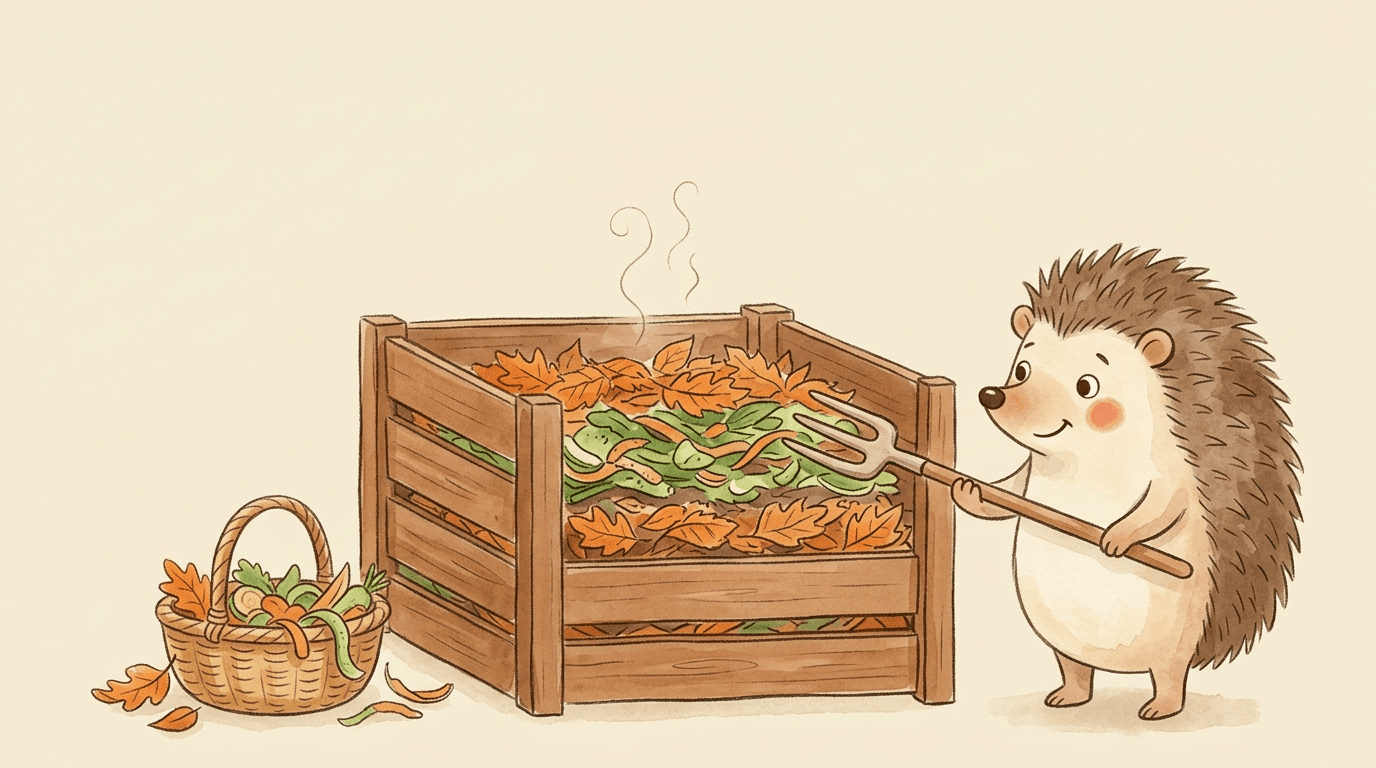
Starting an autumn compost pile: 3 parts leaves, 1 part kitchen scraps
Frau Schneider's compost pile just sat there all winter. No steam on cold mornings, no warmth, no breakdown — just a heap of dry leaves that hadn't changed a bit by March. The problem wasn't patience. It was the mix.
October 20, 2026 · 3 min read
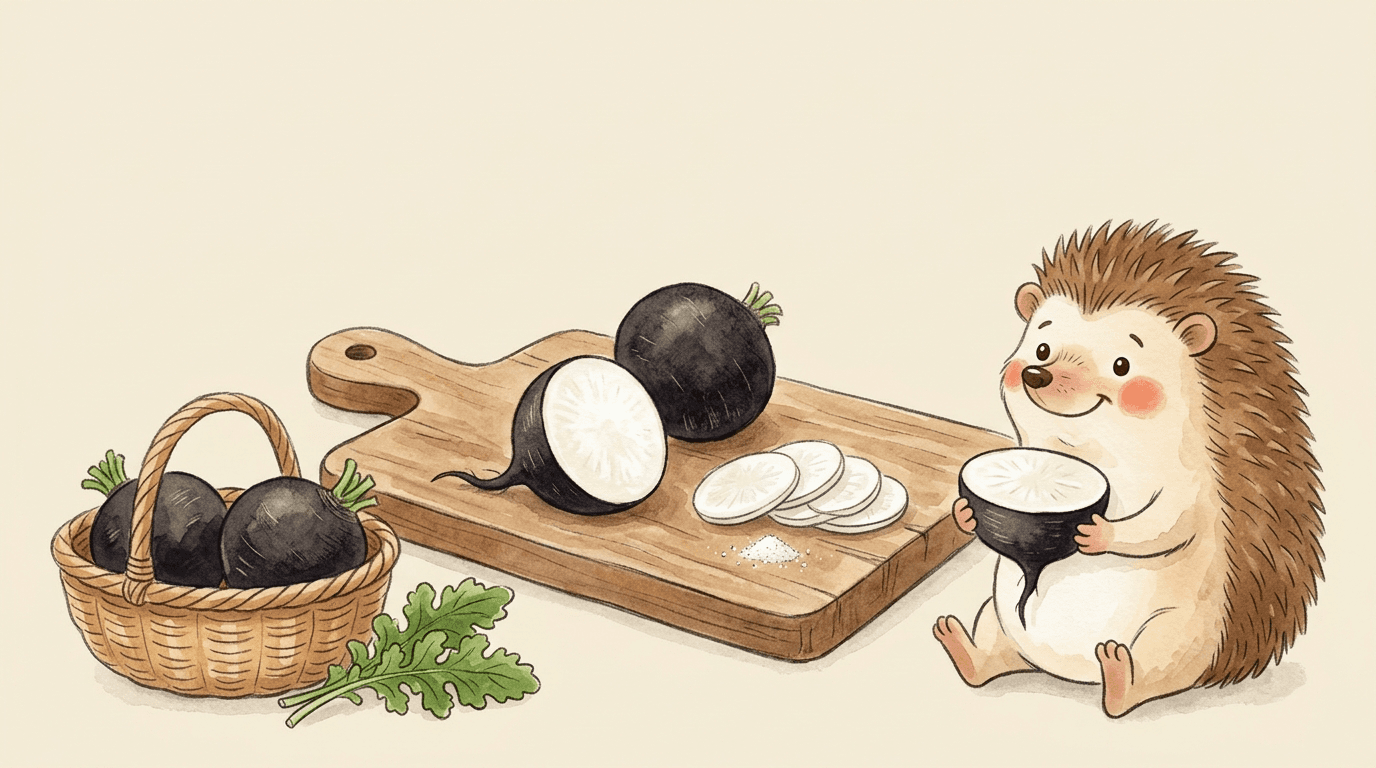
Black radish: why you should let it rest before you bite in
Last year Frau Schneider bit straight into one, unsalted, fresh out of the ground, and spent the next two minutes coughing instead of talking. The problem wasn't the radish. It was the timing.
October 14, 2026 · 2 min read
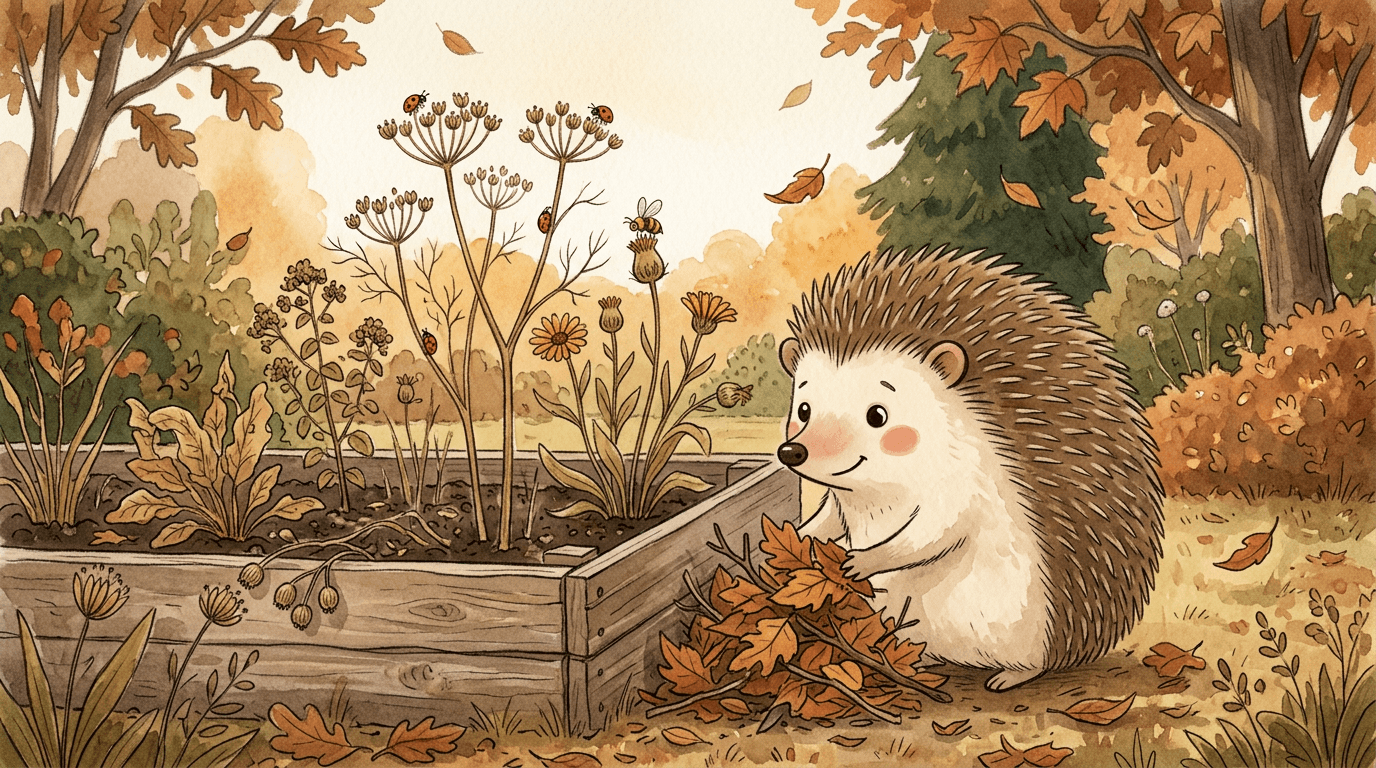
Why I only tidy up half my raised bed in October
Mr Zimmermann cut his entire raised bed down to the ground in one afternoon — stalks, seed heads, leaves, all gone. I should have warned him beforehand: not everything, only half. Here's what should stay standing and what really needs to go.