May 1, 2026 · by Stachi · 7 min read
Companion planting for beginners — who likes whom in the raised bed
Companion planting sounds like a biochemistry degree. It isn't. Fifteen pairing rules, three team players, three loners — and a story about my bed in 2023.
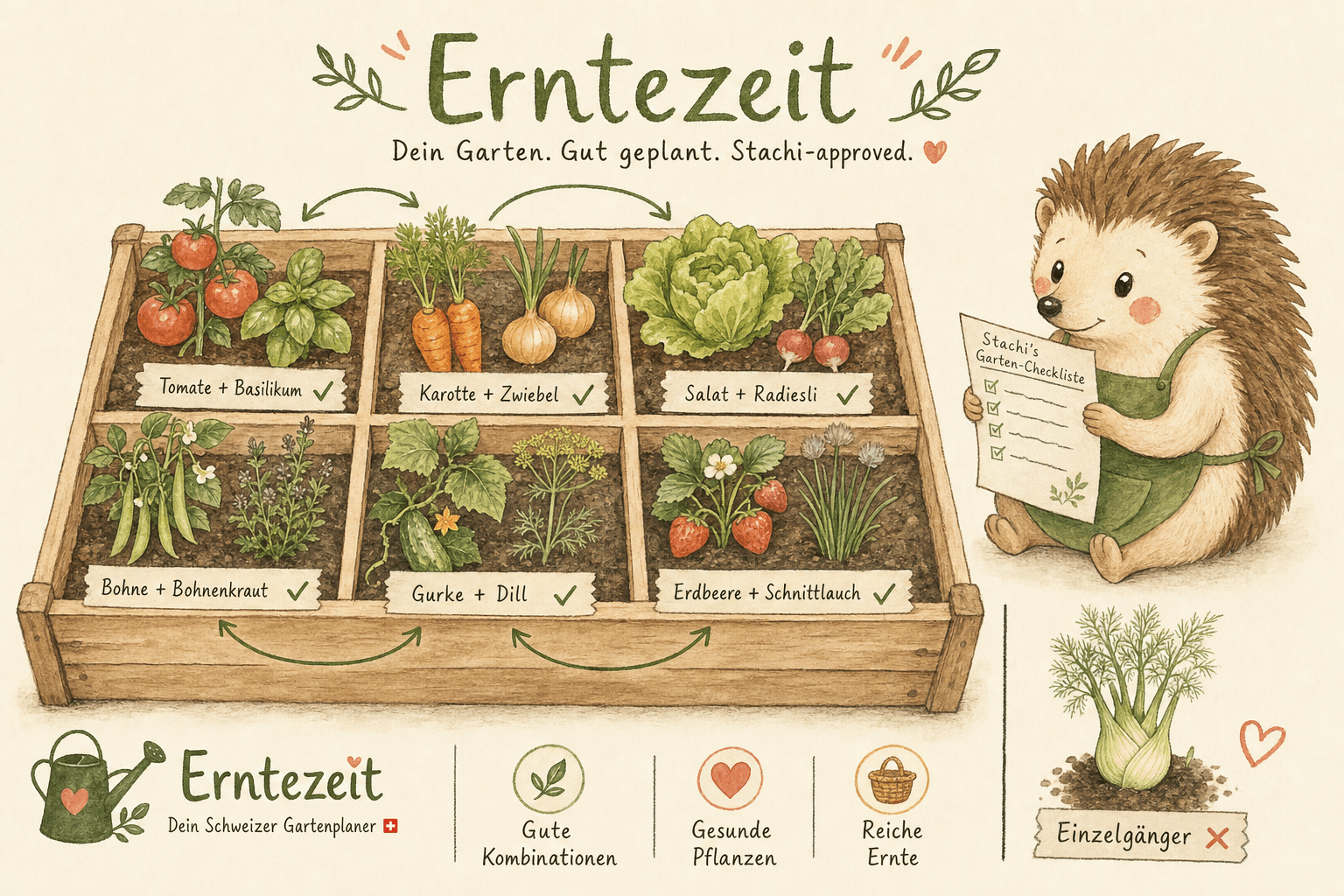
I'll be honest: the first time I saw a companion-planting chart, I thought it was made for people who dream about biochemistry. Thirty rows, two columns for "compatible", one for "incompatible", footnotes about pH and root depths. Frau Schneider from Berikon once showed me a printed-out version — four A4 pages, laminated, with marker highlights. I nodded politely and quietly gave up inside.
The underlying principle, though, fits on a Post-it note.
What companion planting actually does
Plants aren't silent objects that just grow. They send scent signals through the air and chemical messages through the soil, and some even fertilise their neighbours. Four concrete mechanisms:
Pest deterrence through scent. Basil smells of limonene and linalool — both of which aphids dislike. Chives produce sulphur compounds that disorient carrot flies. This isn't garden folklore, it's chemistry. If a pest can't reliably locate where the tasty carrot is, it tends to give up.
Complementary root depths. Lettuce roots are shallow. Carrots go deep. Both can grow side by side without competing for water, because they're drawing from different soil layers. Beans fix nitrogen via root nodule bacteria and release it — which lettuce and kohlrabi planted next to them are very happy about.
Giving and taking nutrients. Legumes (beans, peas) are the nitrogen donors of the raised bed. Plants to follow after beans: cabbage, lettuce, spinach — they benefit from the leftover nitrogen. Plants to avoid right after tomatoes or peppers: more tomatoes or peppers, because they're heavy nitrogen feeders and leave the soil depleted.
Shade and light. Tall plants like tomatoes or beans cast shade. For lettuce in midsummer, that shade is a gift — lettuce bolts fast when it gets too hot. Radishes under lettuce? Radishes break up the soil for lettuce roots and are already harvested within six weeks, before the lettuce even needs the space.
That's the whole principle. Now the table.
The 15 most important pairing rules
Most companion-planting books have 200 entries. I've filtered down to the 15 that actually matter in a raised bed — with the specific reason why.
| Plant A | Plant B | Effect | Compatible? |
|---|---|---|---|
| Tomato | Basil | Basil scents repel aphids and whitefly; tomatoes grow more vigorously | ✅ Yes |
| Tomato | Carrot | Carrots loosen the soil for tomato roots | ✅ Yes |
| Cucumber | Dill | Dill attracts beneficial insects; cucumber pests avoid the scent | ✅ Yes |
| Cucumber | Savory | Savory keeps cucumber pests away and improves flavour | ✅ Yes |
| Carrot | Chives | Sulphur scent of chives confuses carrot fly | ✅ Yes |
| Carrot | Onion | Mutual pest deterrence — a classic tandem pair | ✅ Yes |
| Lettuce | Radish | Radishes loosen soil, lettuce shades radishes in summer | ✅ Yes |
| Lettuce | Strawberry | Lettuce fills gaps around strawberries, no conflict | ✅ Yes |
| Bean | Savory | Savory boosts flavour and keeps black bean aphid at bay | ✅ Yes |
| Kohlrabi | Tomato | Tomato deters cabbage white butterflies from kohlrabi | ✅ Yes |
| Tomato | Potato | Both are nightshades, they share late-blight pathogens — risk doubles | ❌ No |
| Tomato | Fennel | Fennel inhibits tomato growth through anethole secretions | ❌ No |
| Bean | Onion | Onion root secretions inhibit the nitrogen-fixing nodule bacteria on beans | ❌ No |
| Cabbage | Strawberry | Cabbage pests (cabbage white butterfly) also attack strawberry leaves | ❌ No |
| Fennel | Almost everything | Fennel releases anethole and other terpenes that suppress many vegetables | ❌ No |
You don't need to memorise this. Just check whether your desired neighbour is in the top or bottom half of the table before planting.
Three team players
These three plants get on with almost everything in a raised bed. If you're planning and don't know how to fill a gap, reach for these:
Chives. Their sulphur-containing scent keeps aphids, spider mites and carrot flies at a distance. Chives don't bother anyone, take up little space, and grow happily next to tomatoes, strawberries or carrots alike. In my bed in Berikon they stand as a living boundary marker between zones. My little niece calls them "the green hair of Stachi's bed" — I think that's accurate.
Carrot. Loosens deep soil for shallow-rooted neighbours, barely competes for nutrients, doesn't shade. Carrots pair well with tomatoes, onions, lettuce, radishes. Their only enemy on this list: dill planted directly alongside (dill can inhibit carrot germination — so keep them at least a hand's width apart).
Basil. The classic. Not just for tomatoes — basil helps peppers, cucumbers and even lettuce. The scent confuses insects hunting for their host plant. Also: basil planted right next to tomatoes is said to improve tomato flavour. My tomatoes prove it every year. Whether that's biochemistry or wishful thinking, I honestly don't know — but I plant basil next to tomatoes every time regardless.
More about this trio in my post about tomatoes, basil and cucumbers.
Three loners
These three either need plenty of space to themselves, or they actively harm their neighbours. Handle with care in a raised bed:
Fennel. The trickiest case. Fennel releases anethole and other terpenes via its roots — a kind of chemical warfare against competition. Tomatoes, peppers, beans, even basil grow more slowly when fennel is nearby. If you want fennel, put it in its own pot, far from everything else.
Cabbage (all types: kohlrabi, white cabbage, broccoli). Cabbage isn't a bad neighbour because of chemistry — it's the pests. Where cabbage grows, the cabbage white butterfly comes. And the butterfly isn't picky: its caterpillars also strip nearby strawberries, lettuce and radishes. Cabbage also needs a lot of nitrogen and competes aggressively. If you grow cabbage, give it its own corner with distance from your best other plants.
Strawberry. Strawberries don't like competition in the root zone. They're sensitive to many neighbours — especially cabbage (pests) and fennel (terpenes). What works well: a ring of chives around the strawberry patch. What works badly: squeezing strawberries between tomatoes because "there's still space." Strawberries need light from above; a tomato's shade they can survive, but the harvest will disappoint.
My bed in 2023 — what happens when you ignore the rules
I have to confess: 2023, I got it wrong. Classically. I had a new raised bed (120×80 cm), I was enthusiastic, and I decided to put in everything I like to eat.
Tomato. Carrot. Basil. Chives. And then, because I had seedlings left over and it seemed a shame to throw them away: potatoes at the back right, fennel at the back left.
That was not a smart call.
By late July the tomatoes next to the potatoes had late blight. Not just the potatoes, not just the tomatoes — both. Late blight jumps between nightshades like fire. One plant infected, the other is sick within ten days. Frau Schneider from Berikon had warned me about this, my neighbour had the same story, and now I do too. If you want to read more about it: what late blight actually is.
The fennel? It slowed down the tomatoes on that side. Not visibly broken — but the tomatoes on the fennel side had noticeably less fruit than those on the basil side. I only noticed when harvesting and it took me a while to work out why.
End of August: halved tomato yield, potatoes with brown patches, fennel side stunted. Basil and chives were great — because they don't bother anyone.
In 2024 I moved potatoes and fennel to their own pots. Tomato harvest was three times higher.
That's not a coincidence. That's companion planting.
What you don't actually need to memorise
I know the table above has 15 entries. And I know most people stop reading after a page of planting rules.
Here's the shortcut you actually need to remember:
- Tomato + basil belong together. Always.
- Tomato + potato never together. Ever.
- Fennel alone in its own pot. Full stop.
- Chives everywhere — they can't do anything wrong.
That's four rules. Four. If you only know those four, you've avoided the worst mistakes and locked in the biggest wins.
For how to observe and learn from your plant combinations in action, read my post about plants that talk to you.
What Erntezeit takes off your plate
I know some people love these charts. Frau Schneider with her laminated four-page version sleeps better knowing exactly why beans next to savory are happy. That's completely valid.
For everyone else: in Erntezeit I take care of all this in the background. You pick your plants, I check whether neighbours get along, warn you if two don't like each other, and suggest team players to fill the gaps. You see the result, not the calculation.
No laminator required.
Plan your bed for free → /en/planer/standort
🦔 Stachi
Related plants


More articles
October 26, 2026 · 3 min read
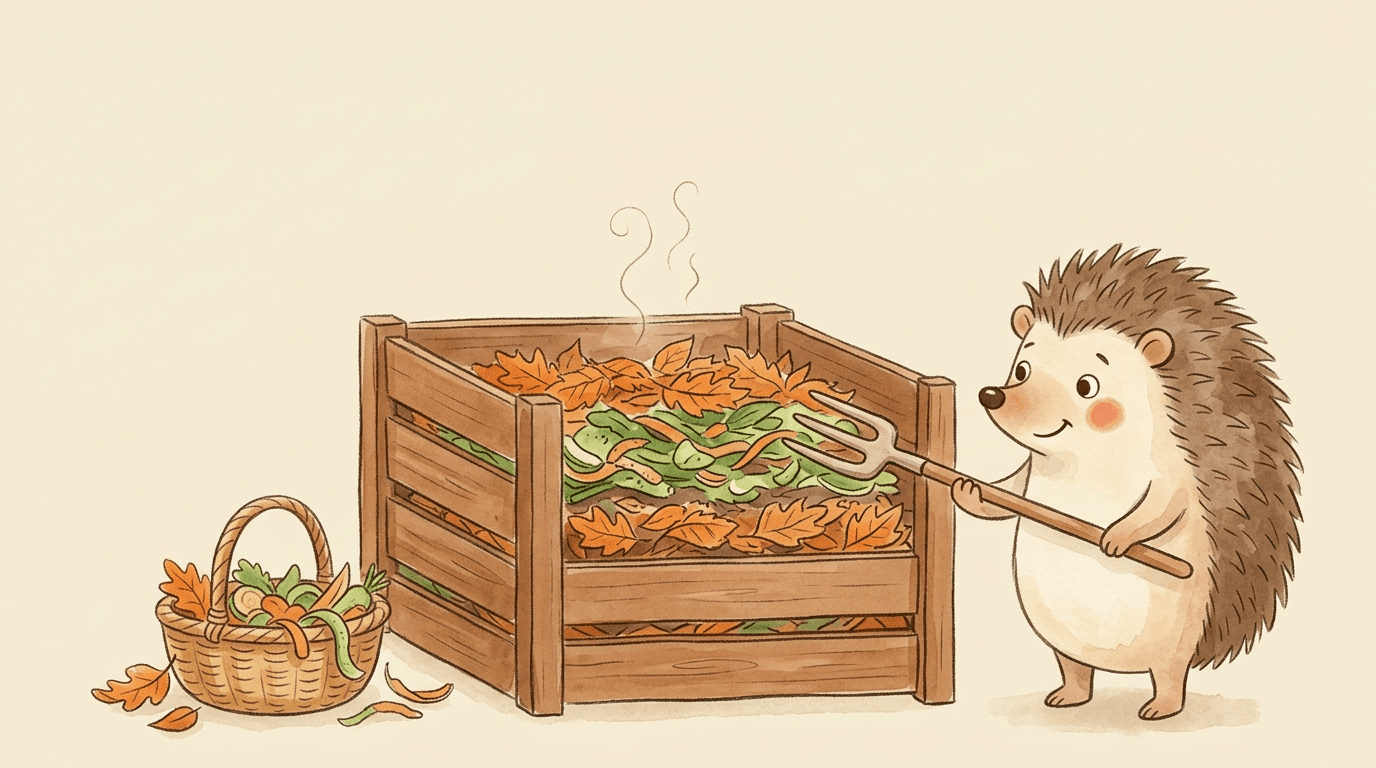
Starting an autumn compost pile: 3 parts leaves, 1 part kitchen scraps
Frau Schneider's compost pile just sat there all winter. No steam on cold mornings, no warmth, no breakdown — just a heap of dry leaves that hadn't changed a bit by March. The problem wasn't patience. It was the mix.
October 20, 2026 · 3 min read
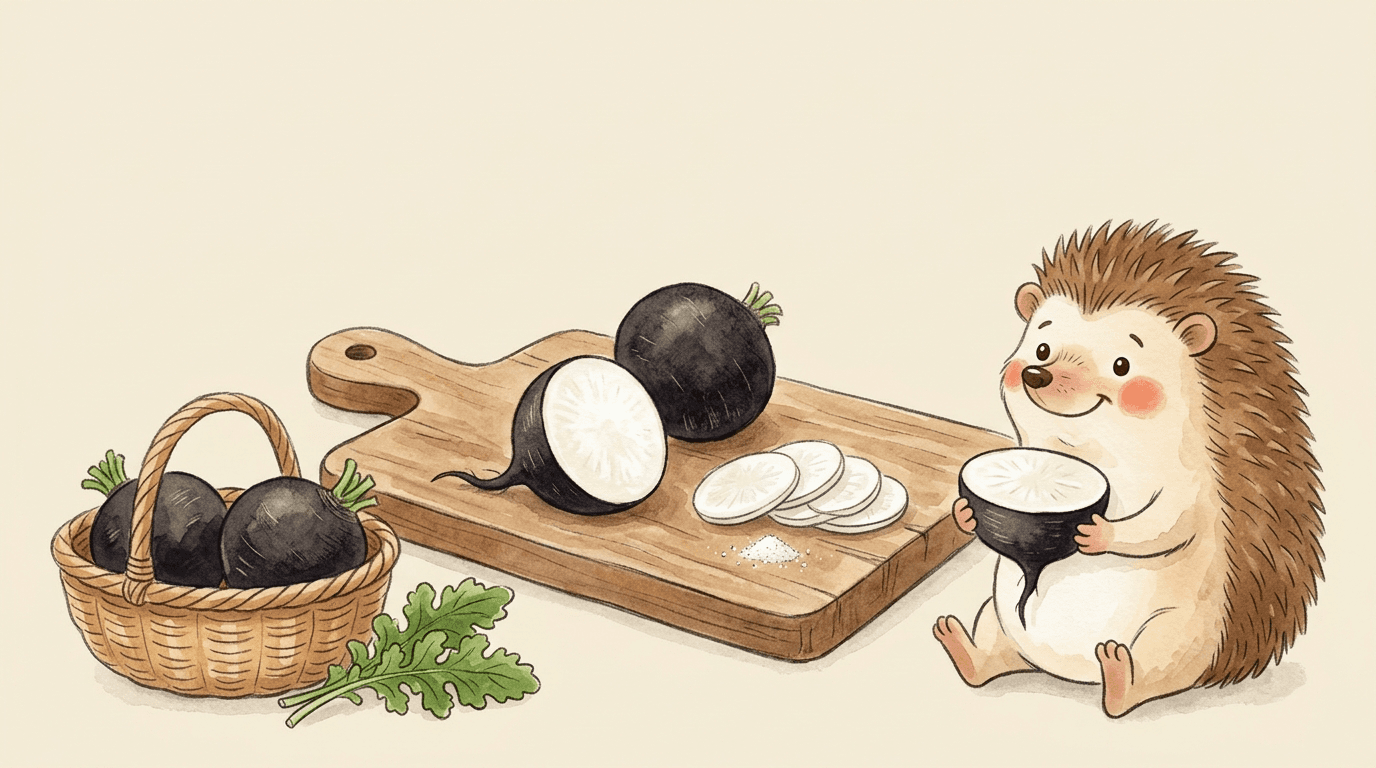
Black radish: why you should let it rest before you bite in
Last year Frau Schneider bit straight into one, unsalted, fresh out of the ground, and spent the next two minutes coughing instead of talking. The problem wasn't the radish. It was the timing.
October 14, 2026 · 2 min read
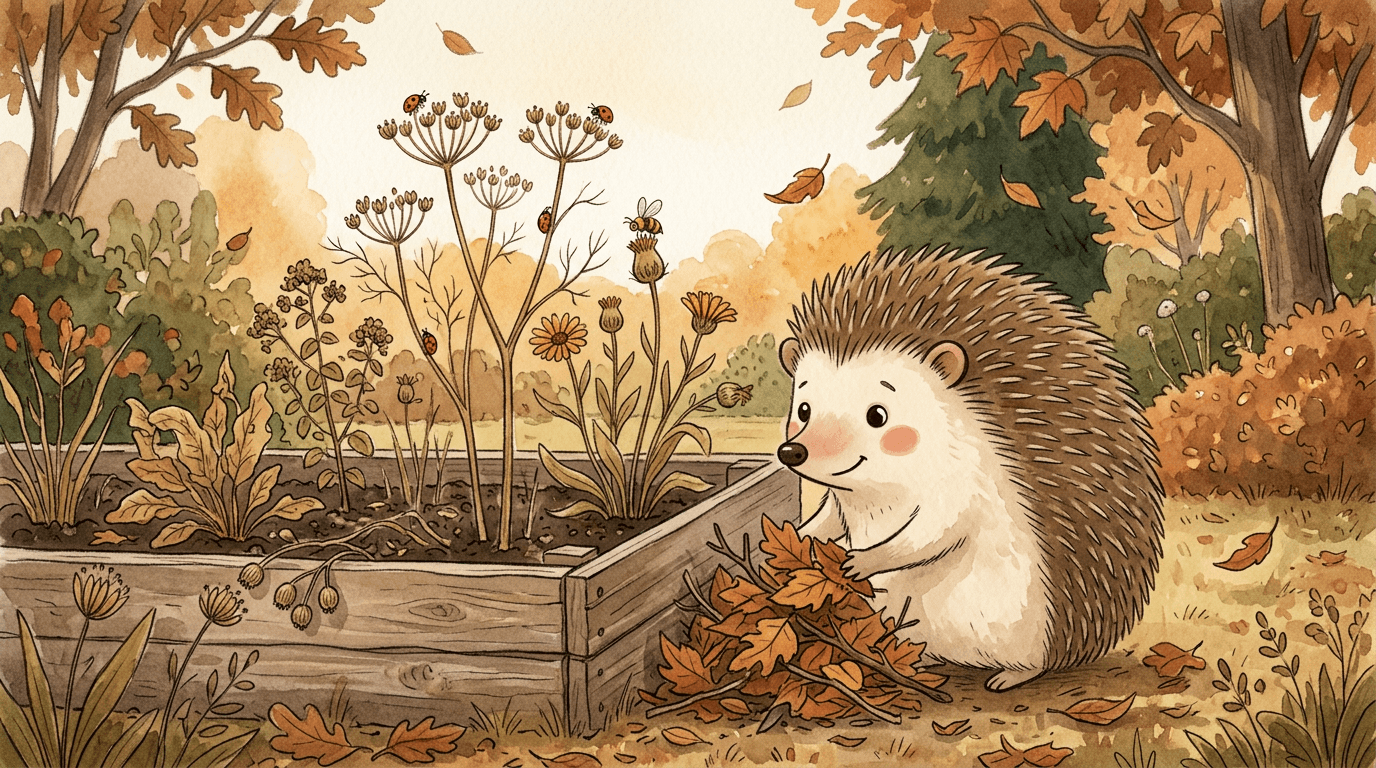
Why I only tidy up half my raised bed in October
Mr Zimmermann cut his entire raised bed down to the ground in one afternoon — stalks, seed heads, leaves, all gone. I should have warned him beforehand: not everything, only half. Here's what should stay standing and what really needs to go.